Multi-Agent Orchestration
One agent runs the crew. Humans approve the plan — not every keystroke.
What was getting in the way.
One AI doing everything serially is slow and expensive — and a human coordinating multiple AI tools becomes the bottleneck, re-explaining context to each one and eyeballing every output. Nobody QAs the QA.
Context
The marketing team's own delivery operations — client site builds and a platform migration run through orchestrated worker lanes.
How the work runs.
- 01
Trigger
the person states the outcome in one message.
- 02
The lead decomposes the work
the lead agent decomposes it into bounded, verifiable briefs (ground rules, exact scope, report-back format).
- 03
Dispatch to the right worker
work is dispatched to the right worker — a specialist build agent for code, cheap fast agents for bulk lanes, in parallel where independent.
- 04
Plans approved before execution
workers propose plans; the lead approves or corrects before execution.
- 05
Workers hire their own help
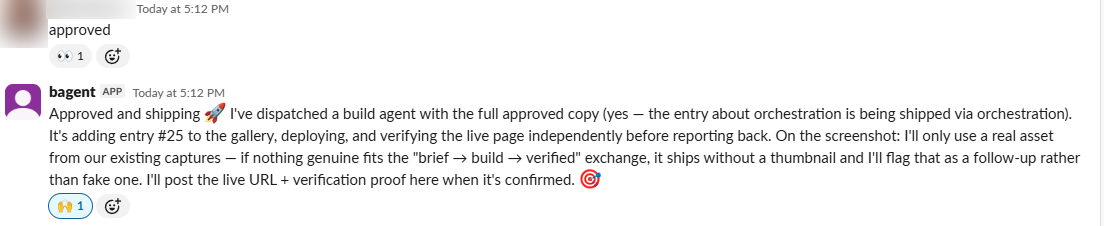
and here's the part that surprises people: the workers hire their own help. When the build agent gets a brief that needs research — say, "match this page's design exactly" — it doesn't come back and ask. It spins up its own smaller agents to go study the reference site, gather the assets, and report back to it, then uses their findings to do the job. The delegation goes two levels deep, and it's all logged.
- 06
The lead verifies independently
the lead never trusts a worker's self-report: it verifies on production independently.
- 07
Re-briefed, not retried blind
drifted or failed work is diagnosed and re-briefed, not retried blind.
- 08
Outcome
the person gets one verified result, with cost, instead of the coordination.
Evidence from the workflow.
Each system has a role.
Worker — code & deploys; spawns its own research sub-agents
AI build platform
Parallel lanes
Low-cost worker agents
Assignment & report
Team chat
Briefs, decisions
Project record
Verification surface
Production site + database
Why this is Coworker.
Takes assignments and reports back. You hand it work, it prepares and returns a result.
- 01
Every brief and plan approval is logged — including sub-worker delegations. Nothing is reported done without an independent production check. Per-cycle cost is tracked and disclosed. Humans set scope at the plan level and can halt any lane.
Impact / Outcomes
More than a dozen production site changes shipped in six days through orchestrated cycles — every one verified live before being reported done.
A 400+-URL platform migration run as parallel worker lanes at a fraction of single-agent cost.
Worker mistakes caught by the lead's verification gate, never by users.
Delegation observed running two levels deep — workers dispatching their own sub-workers without human involvement.
Find where a workflow like this fits.
Start with the systems, work, constraints, and authority already present in your operation.