AI for
agencies.
We know this one. Big Timber came out of an agency we were running, built on the AI we deployed inside our own shop. AI is a tool — it won't replace strategy, taste, or client relationships. But the agencies that compete on tomorrow's delivery timelines will be the ones that built AI into how they already work.
Slack and Teams,
doing the actual work.
The surface is a chat window your team already lives in. The agent reads context from your systems, drafts the work, and waits for your call.
Slack
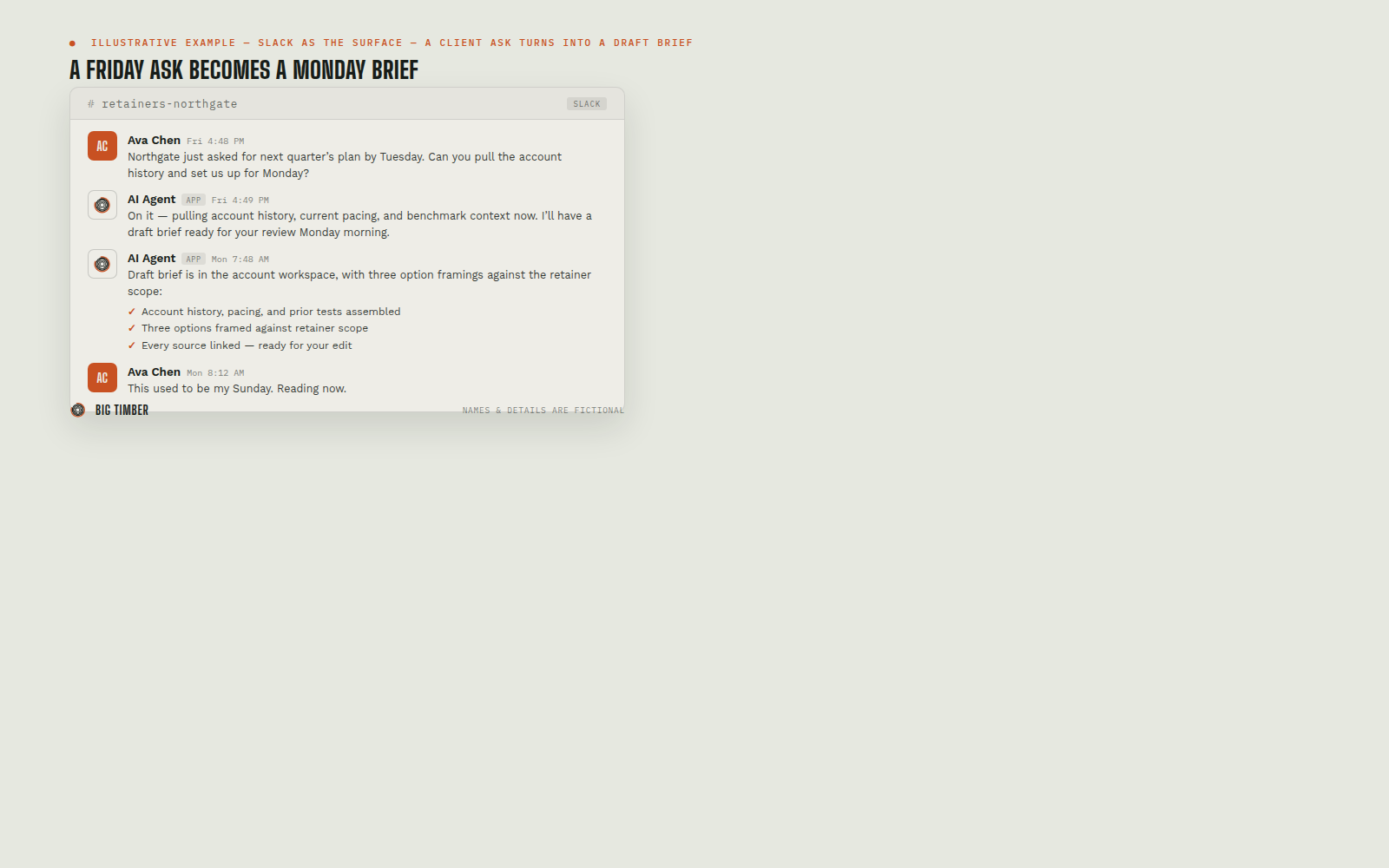
A Friday ask becomes a Monday brief.
A client asks for next quarter's plan Friday afternoon. By Monday, the strategist opens a draft brief with the account's own history, pacing, benchmark context, and three options framed against the retainer scope — every source linked. The thinking still comes from a person. The Sunday assembly does not.
Microsoft Teams
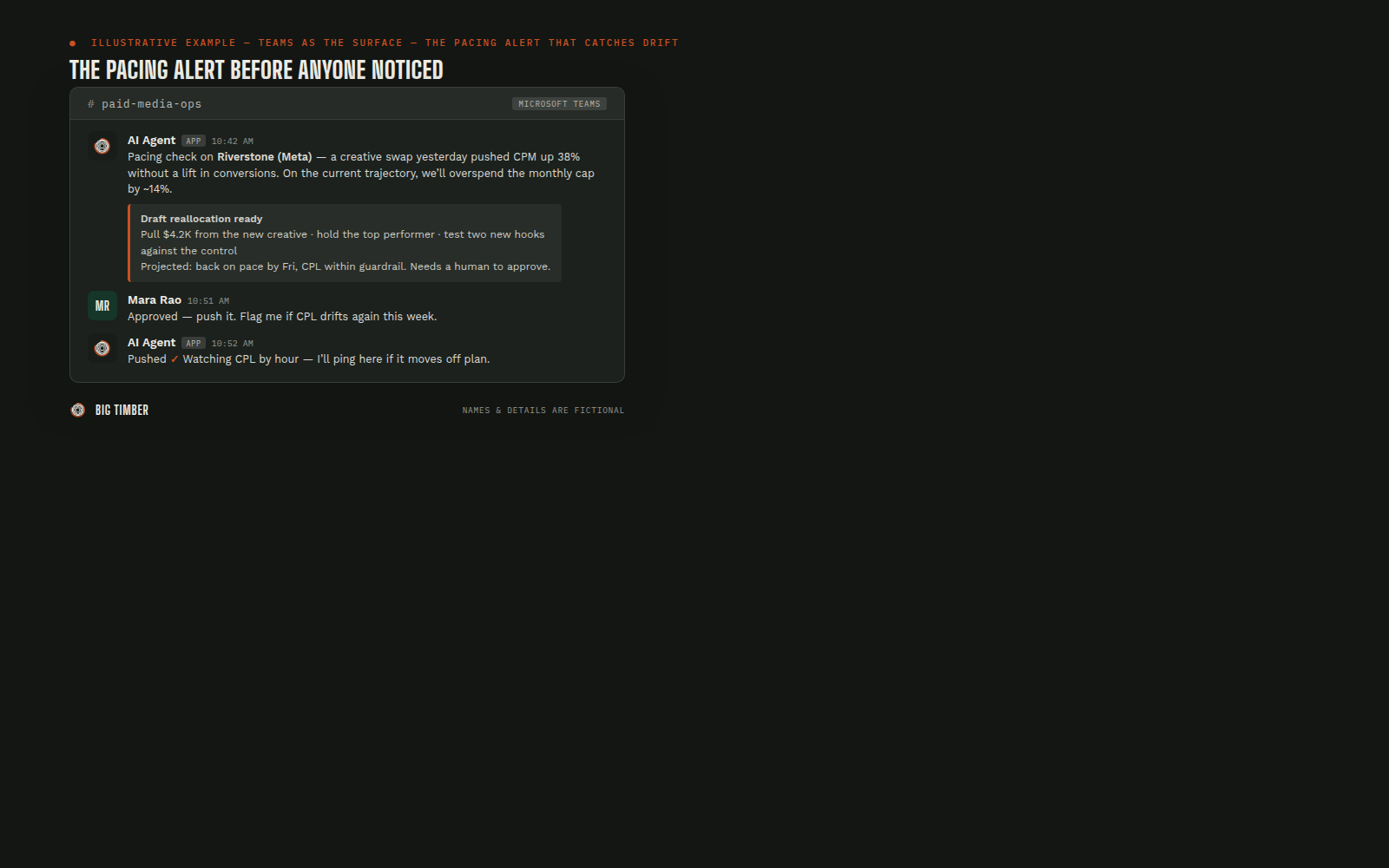
The pacing alert before anyone noticed.
A paid-media account drifts off pace. The agent spots it, drafts a reallocation inside the margin guardrail, and waits for a human to approve before anything moves. Budget decisions stay with the buyer.
Slack
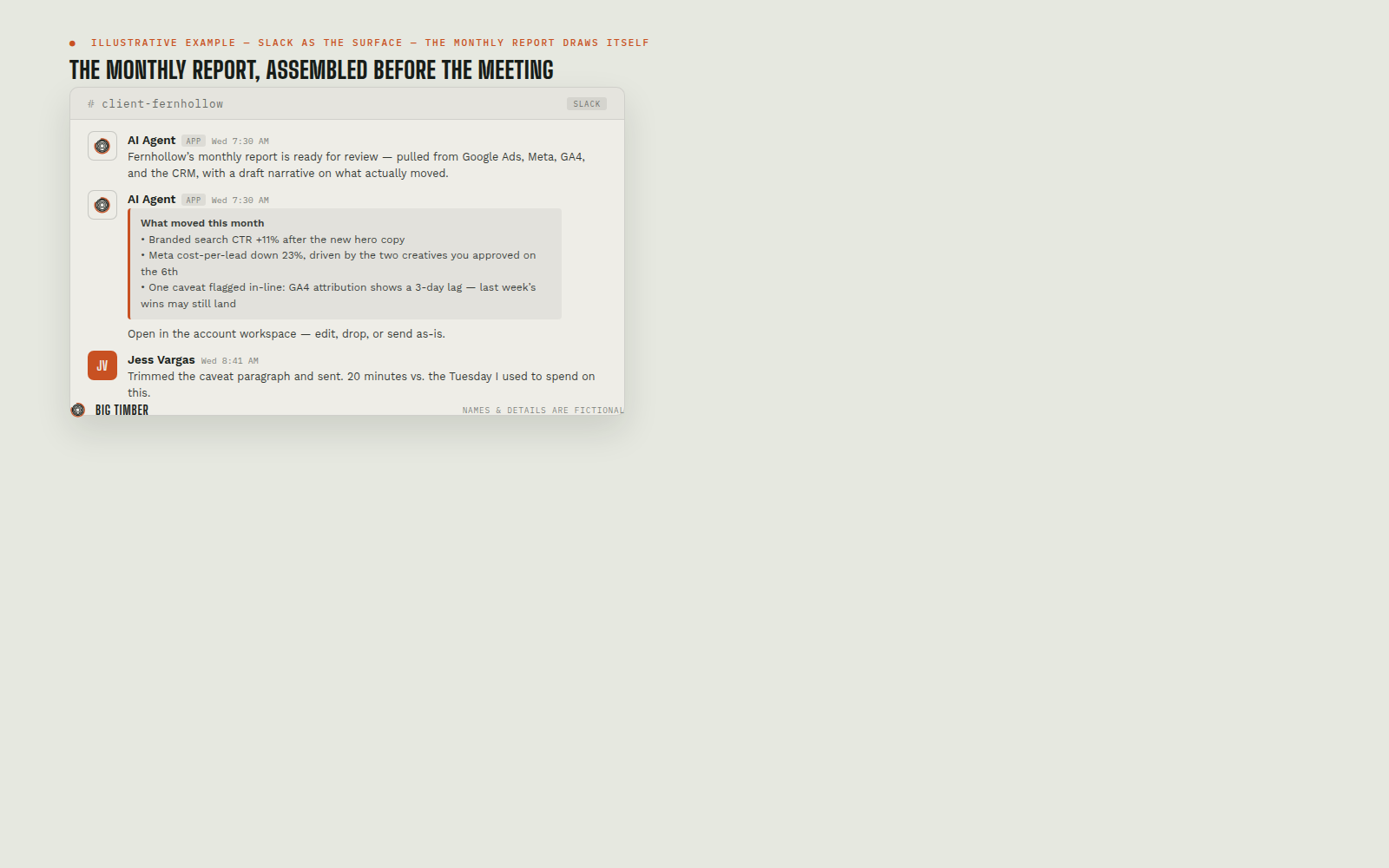
The monthly report, assembled before the meeting.
The monthly client report draws itself from Google Ads, Meta, GA4, and the CRM — with a draft narrative on what actually moved and caveats surfaced in-line. The strategist edits and sends. The Tuesday rebuild is gone.
The work worth
building around.
Not a menu to buy from. These are the shapes we see most often.
Client intake and briefs
Requests captured, structured against the account's history, and routed with context already attached.
Paid media operations
Pacing, drift, naming compliance, and anomaly detection watched continuously. Reallocations drafted; humans approve.
Creative preparation and QA
Briefs assembled from audience, offer, prior learnings, and platform specs. Legal and brand checks run before human review.
Reporting and attribution
Monthly and weekly reports assembled from source platforms, with a draft narrative on what moved and caveats surfaced in-line.
Account management, every day
Status, risks, open approvals, and renewal signals surfaced from the systems that already hold them — not reassembled before every client call.
New business and knowledge
Audits and pitch decks drafted from the agency's own prior work. What worked on an account is captured as it happens, so the next pitch doesn't start from scratch.
What stays
with a person.
The system removes the waiting. The judgment that commits the agency's reputation stays with your people.
- Strategic recommendations and the point of view behind them
- Any client-facing commitment — scope, timing, or deliverable
- Media buying and spend decisions where budget or client expectation is involved
- Creative judgment and final approval of work that goes out under the agency's name
How Big Timber works
We don't start with
a product.
We learn how the agency actually operates, then identify where connected AI creates useful capacity — and where it does not.
See the engagement model →Discover
We learn how the agency actually runs — accounts, disciplines, handoffs, and where work stalls.
Design
We map where connected AI creates capacity, and what stays with a person.
Build
Integrations, context, workflows, approvals, and logging built into your environment.
Train & Maintain
The team is brought with it, and the environment keeps an owner afterward.
Find where AI fits in yours.
A working session against how your agency actually runs. We will tell you where connected AI creates capacity, and where it will not.