OpenClaw Implementation by Big Timber
We implement and manage OpenClaw: the open agent platform that puts AI to work inside the systems your business already runs on. We stand it up, wire it into your operation, build the agents, and train your team. From there, your team runs it or we do: your call.
Backed by our 90-Day Money-Back Guarantee
What OpenClaw is, in plain English
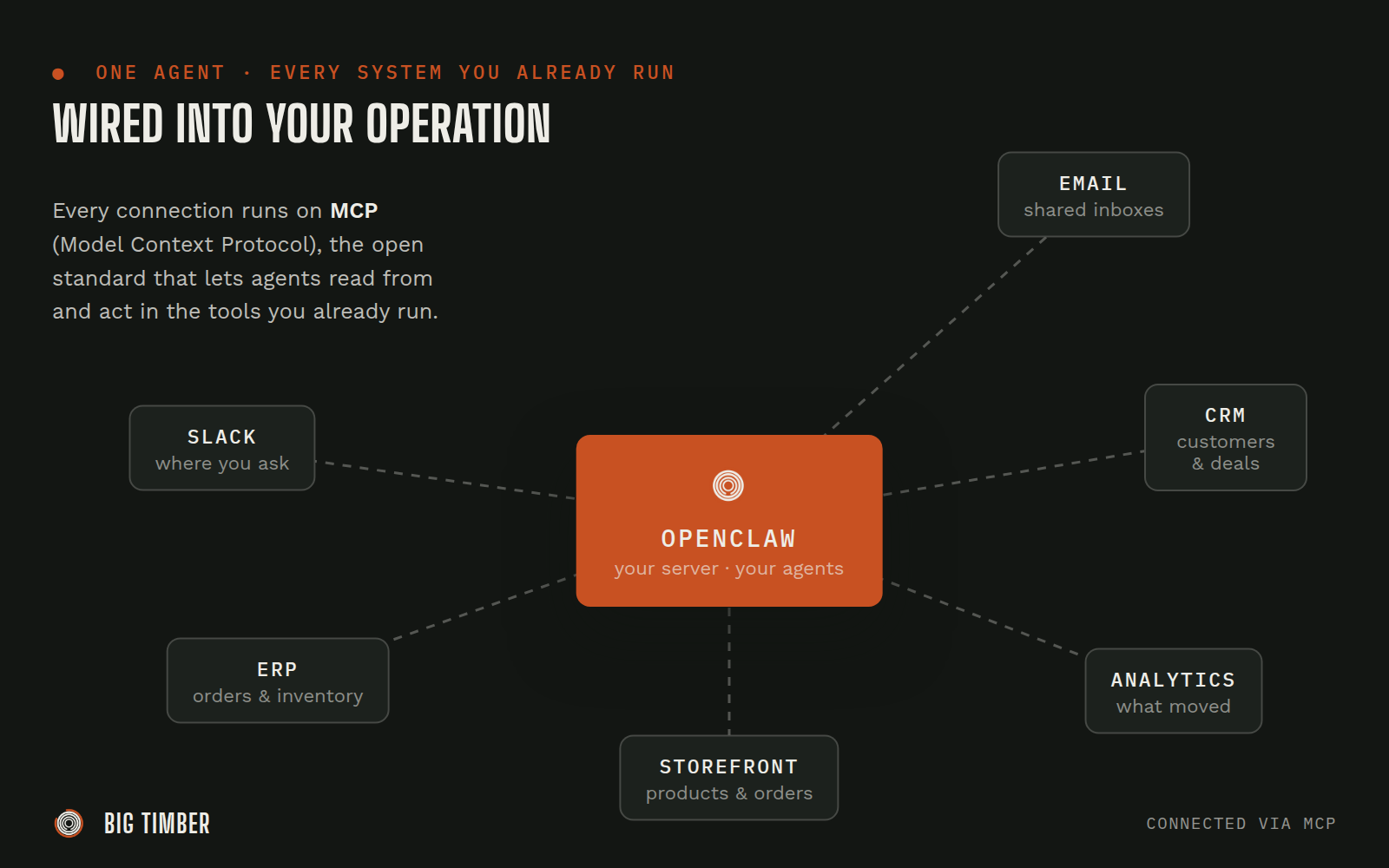
OpenClaw is an open platform for running AI agents inside your business. Not a chatbot in a browser tab, and not another per-seat subscription. It is infrastructure you own: agents that live in your Slack or Microsoft Teams channels and your inbox, connected to the systems where your work already happens.
The connection layer is called MCP (Model Context Protocol), an open standard that lets an agent read from and act in the tools you already run: your CRM, your ERP, your storefront, your accounting system, your analytics, your project tracker. Instead of your team copying information between systems, the agent works across them.
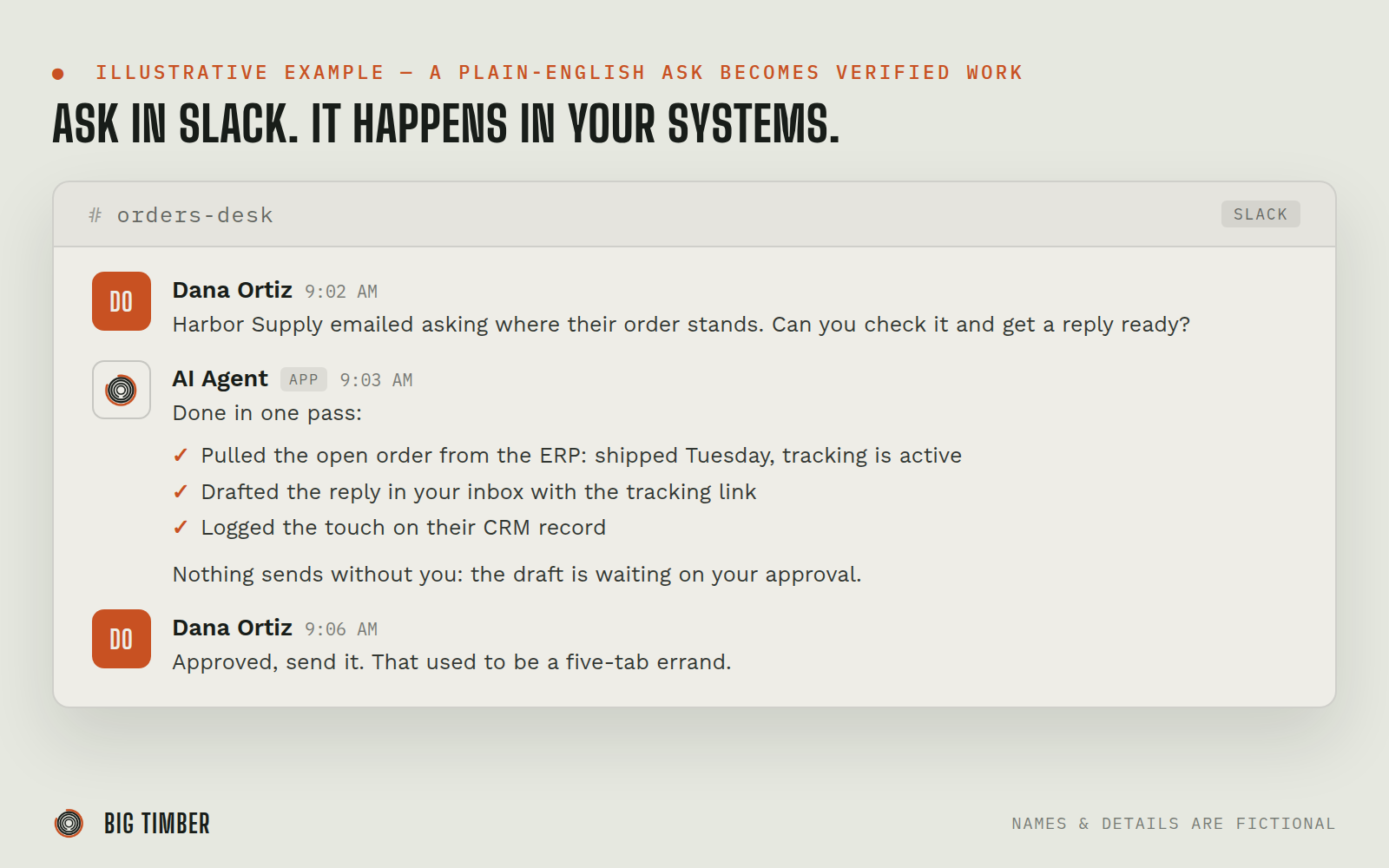
What that looks like day to day: you ask for something in a Slack or Teams channel, in plain English, and the agent does the work. It pulls the order history, drafts the email, updates the record, prepares the report, flags the anomaly. Work that needed a person to shuttle between five tabs gets handled where the conversation already is.
Three things make OpenClaw different from the AI tools most companies have already bought:
You own it. Your own server, your own data, your own agents. No vendor sitting between you and your work, and no per-seat ceiling on who can use it.
It connects. Through MCP, one agent can see your CRM, your email, and your storefront at the same time, which is what most real business work actually requires.
It operates by conversation. You extend it by asking. "Add an agent for the shared inbox." "Teach the sales agent our quoting process." No configuration files, no developer queue.
Two ways to run it
Standing up OpenClaw is the start, not the product. The question that matters is who runs it after launch, and we sell both answers. It is the difference between hiring your own IT team and using an MSP (managed service provider): both get you a working environment; they put the ongoing responsibility in different hands.
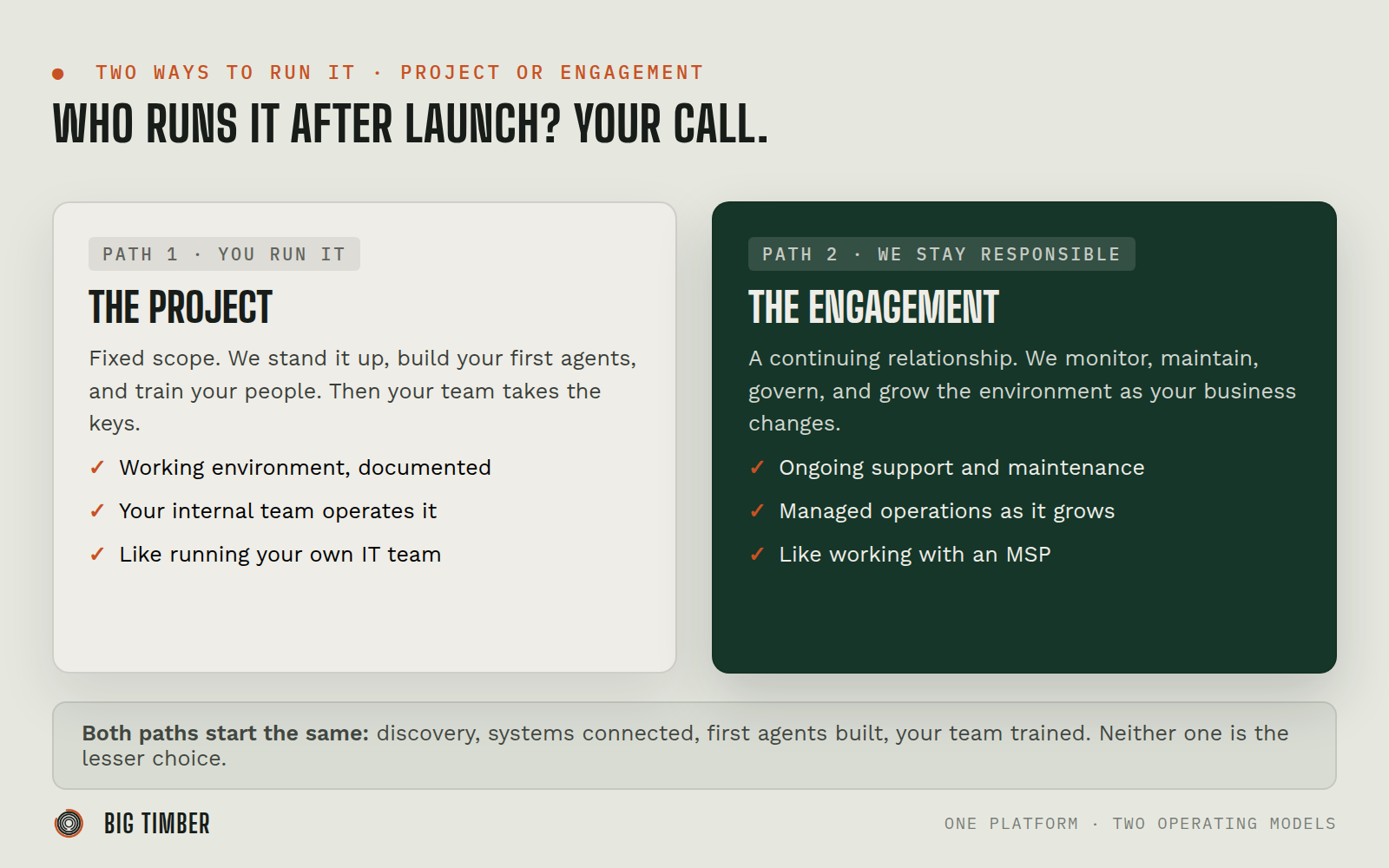
Path 1: The Project. For teams that want to own and operate OpenClaw themselves. We scope it, stand it up, connect your systems, build your first agents, and train your people. You get a working environment with documentation, and your internal team runs it from there, the way a company with its own IT team runs its own servers.
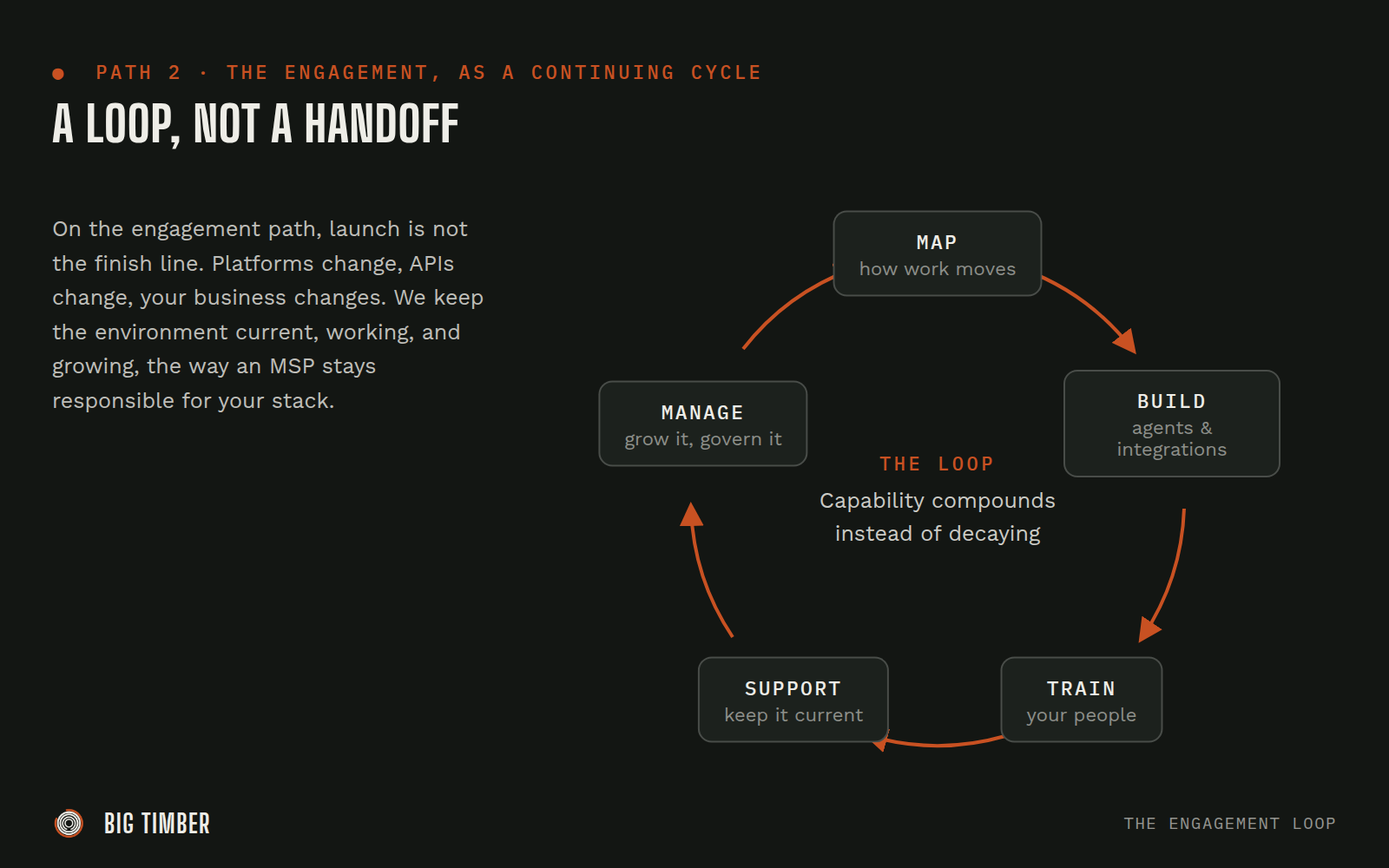
See the fixed-scope projectPath 2: The Engagement. For businesses that want Big Timber to stay responsible, the way an MSP stays responsible: a continuing relationship where we keep the environment current, working, and growing as your business changes. An engagement includes:
Workflow mapping. We document how work actually moves through your operation and where agents can absorb it first.
Strategy. A sequenced plan for where AI creates capacity, in what order, and how each step earns trust before the next one ships.
Build and integration. Your OpenClaw environment, stood up on infrastructure you own and wired into the systems you already run.
Team training. Your people learn how to work with the agents, how to ask for new capability, and when to step in.
Ongoing support and maintenance. Platforms change, APIs change, your business changes. We keep the environment current and working.
Managed operations. As the environment grows, we monitor it, govern it, and expand it, so the capability compounds instead of decaying.
Neither path is the lesser one. Teams with the appetite to run their own infrastructure do well on the project. Businesses that want the capability without carrying the operational load do well on the engagement. If you are not sure which fits, that is what the scoping call is for: we will look at your operation and recommend one.
How we deploy it
OpenClaw is powerful because it is open. That same openness means the early decisions matter: hosting, access, how agents reach your tools, how they remember, how spend stays controlled. We have made those calls many times. Here is how every deployment begins, on either path:
1.
Discovery.
We learn how your operation actually works: the workflows, the handoffs, the repetitive retrieval and routing that eats your team's day. We identify where agents create real capacity first, and in what order.
2.
Connect your systems.
We provision your OpenClaw environment on infrastructure you own, then wire in the tools you already run: Slack or Teams, email, Google Workspace, your CRM, ERP, storefront, finance, and analytics, via MCP integrations. Permissions, access rules, and cost controls go in on day one.
3.
Build workflows and agents.
Your first agents go live on their own Slack or Teams channels, trained on how your business works: your terminology, your processes, your approval rules. Anything with real consequences waits for a human sign-off.
4.
Train your team.
A workflow nobody understands is not implemented. We teach your people how to work with the agents, how to ask for new capabilities, and how to tell when something needs a human.
5.
Run it.
This is where the paths diverge. On a project, your team takes the keys with full documentation and runs the environment. On an engagement, we carry that load: we monitor, maintain, govern, and expand the environment so the capability compounds instead of decaying.
Taking the project path?
Our fixed-scope OpenClaw Implementation covers it: your box, your first agents, your integrations, and a trained team, with a fixed quote after a scoping call.
Why we build on OpenClaw, not the alternatives
We are an implementation firm, not a software vendor. We evaluated the field, and we deploy OpenClaw because it wins for connected, multi-system work. The honest reasons:
1.
Ownership beats renting.
Per-seat copilots keep your data, your agents, and your ceiling inside someone else's product. With OpenClaw, the box, the data, the agent definitions, and the accumulated knowledge are yours on day one. If we disappeared tomorrow, your system keeps running.
2.
Connected beats siloed.
Point automations (the Zapier pattern) solve one workflow at a time, and none of the pieces know what the others changed. OpenClaw agents hold context across your systems, which is what real operational work looks like.
3.
Conversation beats configuration.
OpenClaw is operated by asking, in the channels your team already uses. Adoption is the hard part of every AI rollout, and tools that live where the work already happens get used.
4.
Open beats locked-in.
OpenClaw is built on open standards (MCP) and open-source foundations, with your choice of underlying AI models. When a better model ships, your environment uses it. You are not betting the business on one vendor's roadmap.
And the honest caveat: OpenClaw is not the easiest platform to stand up well. That openness is exactly why an experienced implementation partner earns its keep, and it is the business we chose to be in.
New to all of this?
Read our plain-English comparison: OpenClaw vs. copilots, point automations, and custom builds.
What it does in practice
We publish the work. Our use-case gallery documents real workflows running on OpenClaw deployments: website edits requested in plain English and verified live, proactive morning briefings assembled from every system, lead follow-up that starts the moment a form is submitted, reporting that used to take an afternoon prepared before the day starts.
The examples on this site are illustrative, with names and details changed, but the workflows are real ones we have built and run. We talk in terms of time recovered and work absorbed, not inflated numbers.
Explore the workflows →Who should not buy this
An honest answer saves everyone time. OpenClaw, and our implementation of it, is probably not the right call if:
Your data cannot leave a regulated perimeter and your compliance team has not approved AI tooling. Healthcare, defense, and some financial workloads need that conversation settled first. We will not talk you around your compliance team.
Nobody in the business will own it. OpenClaw runs on infrastructure you own, and that means someone on your side cares that it exists. On the engagement path we carry the operational load, but a business with zero internal ownership appetite does better with simple SaaS.
You need exactly one narrow workflow automated. If the whole problem is "send form fills to a spreadsheet," a point automation is cheaper and we will tell you so.
You want a pilot to impress the board, not capacity. We build infrastructure that carries weight. If the goal is a demo, we are the wrong firm.
If you are unsure which side you are on, that is what a demo call is for. We will tell you straight.
Our 90-Day Money-Back Guarantee
AI implementation is hard to price against a guaranteed outcome before we understand your operation. That does not mean you should carry all the risk. If you are not satisfied with the work in the first 90 days, you get your money back. Our incentives sit behind making the work worthwhile, not behind getting the contract signed.
How the guarantee works →Frequently asked questions
What is OpenClaw?+
OpenClaw is an open platform for running AI agents inside your business. Agents live in your Slack or Microsoft Teams channels and inbox and connect to the systems you already run, your CRM, ERP, storefront, and analytics, through MCP integrations. You own the infrastructure, the data, and the agents.
What does an OpenClaw implementation cost?+
It depends on how you want to run it. The fixed-scope OpenClaw Implementation project gets a fixed quote after a scoping call; pricing details are on that project page. Ongoing engagements, covering support, maintenance, and Managed AI Operations, are scoped to your operation as a continuing relationship.
Is Big Timber an official OpenClaw partner?+
No, because none exists: OpenClaw is an open-source project with no official certification or partner program today. Big Timber's credential is production experience. We are an independent firm that builds and operates OpenClaw deployments and MCP integrations for businesses.
Do we need technical staff to run OpenClaw?+
It depends on the path. On an engagement, no: we carry the technical load end to end, and day-to-day use is asking in plain English in Slack or Microsoft Teams. On a project, you do not need developers, but you do need someone on your side comfortable with terminal access, because your team operates the environment after handoff.
How is OpenClaw different from ChatGPT or Copilot seats?+
Per-seat copilots are individual assistants in a separate console. OpenClaw is shared infrastructure your business owns: agents connected to your actual systems, working in the channels your team already uses, with no per-seat ceiling.
What does the 90-day money-back guarantee cover?+
If you are not satisfied with the work in the first 90 days, you get your money back. It exists so Big Timber carries some of the implementation risk instead of the buyer carrying all of it.
See OpenClaw running on your business
Book a demo and we will show you a live OpenClaw workspace: agents on Slack or Teams channels, connected to real systems, doing real work. If it fits, we will come back with a scope, an agent list, and a recommendation: project or engagement, whichever fits how you want to run it.