Moving a Domain Off a Former Agency's Cloudflare Account: How an AI Agent Backed Up Every DNS Record and Kept Email Working
A business was launching a new website and found that its domain's settings sat in a Cloudflare account owned by a marketing agency it was leaving. The agent mapped every record, pushed for a backup before access could disappear, and checked the new setup record by record, so the website and email both kept working through the move.
What was getting in the way.
Many small businesses do not control their own DNS, the settings that tell the internet where a domain's website and email live. A past agency set it up in the agency's own account, and it stays there for years. When the relationship ends, the business is one removed login away from losing the only copy of those settings. Rebuilding them from memory is how email quietly stops arriving: one missed record and messages bounce or land in spam.
Context
A local business changing marketing providers and launching a new website at the same time. Nobody involved was a DNS or Cloudflare specialist. The pattern is common: the domain is yours, but the settings that make it work are sitting in someone else's account.
How the work runs.
- 01
Read what the public can see.
The agent looked up every record it could reach from the outside: where the website points, where email is delivered, and the records that prove the business's email is genuine.
- 02
Say what cannot be seen.
Two email-signing records could not be read from the outside. The agent named them and said the only reliable source was an export from the Cloudflare account itself.
- 03
Push for the backup first.
Its first recommendation, ahead of any launch work, was to export the full settings file that day, because the account belonged to the former agency and access could be removed at any time. It also said plainly that it could not log in to do the export itself, and that it was a one-minute job for a person with the login.
- 04
Rebuild, then compare line by line.
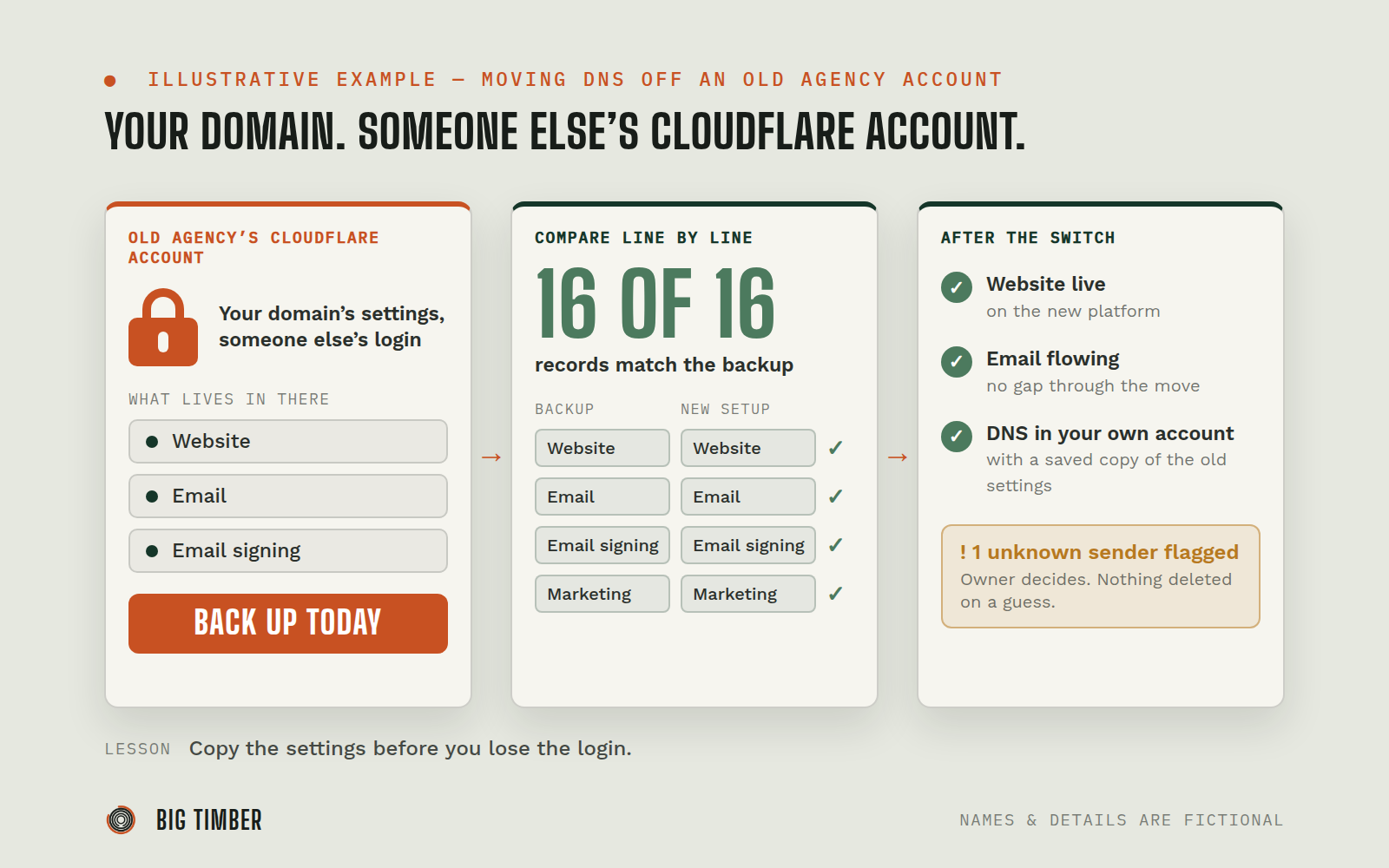
A team member rebuilt the records at the domain's registrar. The agent compared the new setup against the backup, found mismatches on the first pass, and after they were corrected confirmed all 16 records matched exactly.
- 05
Sequence the switch for zero gaps.
Point the old setup at the new website first, switch in a quiet evening window, and leave the old Cloudflare setup untouched as an instant way back.
- 06
Audit after the move.
A follow-up check of the live records found entries for an email-sending service nobody on the team recognized. The agent flagged them for the business to confirm or remove, instead of deleting anything.
Evidence from the workflow.
Each system has a role.
where the former agency had been hosting the domain's DNS
Cloudflare
the registrar, and the new home for the DNS records
GoDaddy
the business's email, the top risk during the move
Google Workspace
marketing email records that also had to survive
HubSpot
where the plan, the comparisons, and the flags were posted
Slack
Why this is Operator.
Owns a workflow end to end, running the process inside the authority you set.
- 01
The agent never held the Cloudflare login. Humans did the export and entered the new records, and the agent did the reading, comparing, and checking. Nothing was deleted on a guess: records nobody could explain were raised with the business owner, in writing, with the team's sign-off.
Impact / Outcomes
16 of 16 records in the new setup matched the backup exactly before the switch.
The website went live on the new platform and email kept flowing through the move.
The business now holds its own DNS, with a saved copy of the old settings.
One set of unexplained records from an unknown email service was surfaced for the owner to decide on.
Find where a workflow like this fits.
Start with the systems, work, constraints, and authority already present in your operation.