Design Showdown — twelve design concepts, one scored competition
Don't pitch one design. Stage a competition — judged by the client's own words.
What was getting in the way.
Design is the riskiest deliverable in an engagement. You're usually shown one direction, defended by whoever made it — and the client can't tell whether they're seeing the best option or just the first one. Feedback rounds turn into taste arguments, and nobody can say what exploring a second direction would have cost.
Context
A live client engagement — the competition ran the same week as the client's kickoff call, narrated in the team's own channel.
How the work runs.
- 01
The brief becomes the law
The client's verbatim design language from kickoff (their vibe words, their hard "never do this" rules) is written down as the scoring rubric before a single pixel exists.
- 02
Field the competitors
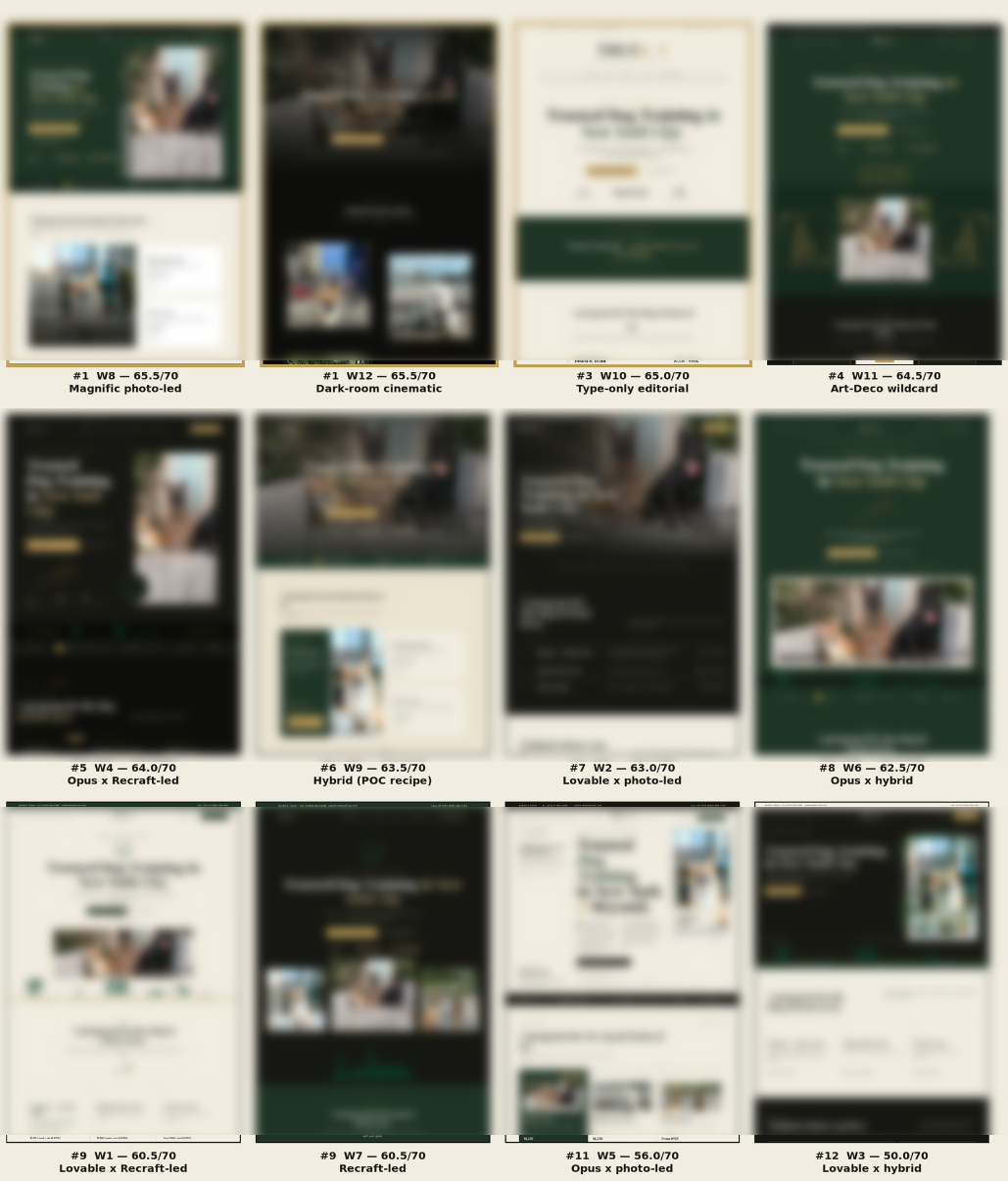
Parallel worker lanes each build a complete design concept led by a different creative engine: Lovable's AI builder and Claude Opus agent lanes doing the building, with Recraft (custom vector illustration) and Magnific/Freepik (real stock photography + photo enhancement) leading the art directions — illustration-led, photography-led, hybrid, type-only, plus wildcards.
- 03
Roll controlled variety
Layout and palette variations are assigned per concept and recorded, so the field explores instead of repeating itself.
- 04
Narrate it live
Every concept drops into the team channel with screenshots as it finishes; the humans watch the competition happen.
- 05
Referee against the rubric
An independent scoring pass grades all concepts against the client's own words (not the maker's taste); the top three get a polish round.
- 06
Deliver a decision, not a debate
One bound document: the current-state baseline, every concept, the scorecard, and the polished finalists — with the metered cost of the whole show.
Evidence from the workflow.

Each system has a role.
The arena — scratch workspace; production untouched
Lovable (AI site builder)
The competing creative engines — vector illustration and real stock photography + photo enhancement
Recraft + Magnific/Freepik
The drafting tables
Isolated Claude Opus worker agents
The live broadcast
Team chat
Record of truth — every dollar measured
Cost meters
Why this is Coworker.
Takes assignments and reports back. You hand it work, it prepares and returns a result.
- 01
The production project is never touched — all competition work happens in a throwaway workspace. Client hard constraints (banned palettes, real photos only, banned claims) are pass/fail, not style points. Every concept, score, and dollar is logged; costs come from meters, never estimates. The referee ranks — humans and the client choose.
Impact / Outcomes
12 complete design concepts plus a polished top-3 delivered in a single session as a 19-page scored decision document.
Every concept judged against the client's own kickoff rules — "must not look AI-made" was the client's law, so it was the referee's law.
The entire competition metered to the dollar: about $26 of model spend plus small metered credits on each design platform — a fraction of one traditional design round.
Find where a workflow like this fits.
Start with the systems, work, constraints, and authority already present in your operation.