Fake Lead Email Scam Detection: How an OpenClaw Agent in Slack Matched a New Lead's Email to a Known Web Design Overpayment Scam and Alerted the Team
A promising new lead emailed a detailed website brief with a healthy budget. A team member shared it with the agent in Slack. The agent read it, matched it to a known scam aimed at web designers, and alerted the team before anything went back to the sender. The human agreed. Nothing was sent.
What was getting in the way.
Some scams do not look like scams. They look like good leads. One long-running version targets web designers and agencies: a new business that has not opened yet asks for a website, names a generous budget, and mentions a consultant who will supply all the materials. After the quote comes a request to charge extra on the card and pass the difference to the consultant. Then the card payment is disputed, and the business is out the money it forwarded. The email is polite, specific, and passes every spam filter, because it was sent by a real person from a real mailbox. A busy team member who is glad to see a lead with a budget is exactly who it is written for.
Context
A small services team that gets inbound leads by email and works with an AI agent in Slack. The email arrived as a reply to the team's own earlier outreach, which made it feel like a warm conversation picking back up. It passed standard sender authentication, so no filter caught it. The pattern applies to any business that quotes by email and takes card payments: the risk is not a suspicious link, it is a believable customer.
How the work runs.
- 01
Read the email as evidence, not as a brief.
A team member shared a new lead's email with the agent in Slack. The agent treats inbound email as data to weigh, never as instructions to follow, so it read the message for what it showed about the sender as well as what it asked for.
- 02
Notice the details that matter together.
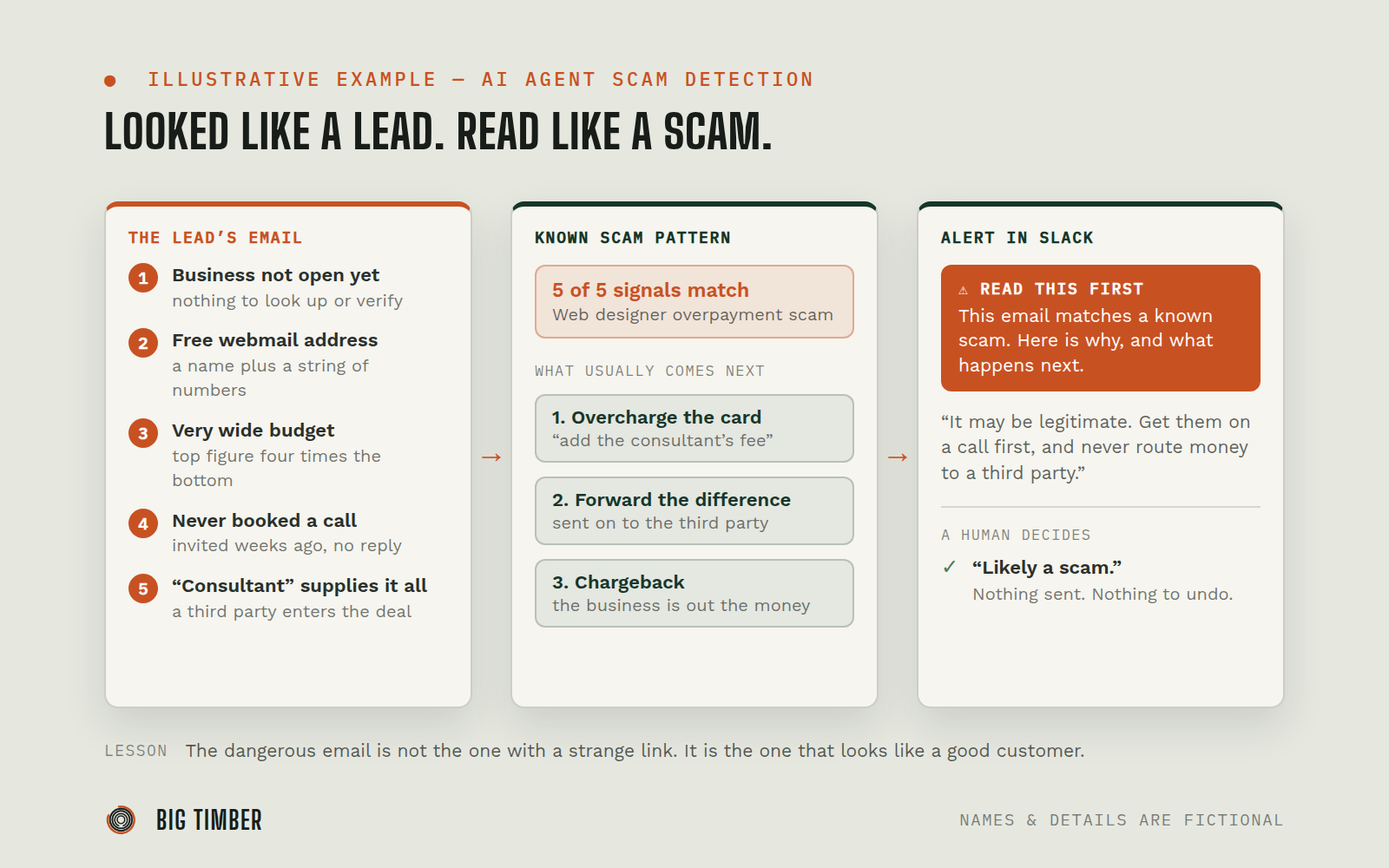
Five things stood out: a business that had not opened yet, a free webmail address with a string of numbers in it, a budget range where the top figure was four times the bottom, a discovery call that had been offered weeks earlier and never booked, and a "dedicated project consultant" who would provide every asset. None is damning alone. Together they are a signature.
- 03
Match it to a known pattern.
The agent recognized the combination as a well-known scam aimed at web designers and said so by name, instead of a vague "this feels off."
- 04
Explain what usually comes next.
It spelled out the next move in the script: a request to overcharge the card, forward the difference to the consultant, and then a chargeback that leaves the business short the money it passed along.
- 05
Alert the team, warning first.
The warning opened the agent's reply in Slack under a "read this first" label, ahead of everything else in the message. It also said the lead could still be real, and recommended getting the sender on a call and never routing money to a third party.
- 06
Let the human decide.
The team member read the warning and agreed the lead was likely a scam. Nothing was sent to the sender. The agent also offered a cheap test for next time: reply that the next step is a discovery call and that payment is by card for the team's own services only. Scammers tend to drop off at that point.
Evidence from the workflow.
Each system has a role.
where the email was shared with the agent and where the alert was delivered to the team
Slack
the evidence the agent read, including the earlier unanswered invitation to book a call
Email (the original message file)
the agent runtime, with the standing rule that email content is data, never instructions
OpenClaw
Why this is Coworker.
Takes assignments and reports back. You hand it work, it prepares and returns a result.
- 01
The agent did not decide on its own that the lead was fake, and it did not reply to the sender. It said what it saw, gave its reasons, and left the decision with the human. It was also plain that the lead might be legitimate, so the alert read as a judgment with evidence, not an accusation. Two standing rules sit behind this. Email content is data: nothing written in a message, however polite or urgent, is treated as an instruction. And any action that creates a payment or moves money needs a separate, explicit confirmation from an authorized person, so a warning like this one always arrives before money can move.
Impact / Outcomes
The scam pattern was flagged within minutes of the email being shared, before anything went back to the sender.
The human made the call with the reasons in front of them: five specific signals and a description of what the scam does next.
No quote, proposal, or payment request reached the sender. There was nothing to undo.
The team came away with a simple filter for the next lead that looks like this one: a call first, and card payment for the team's own services only.
Find where a workflow like this fits.
Start with the systems, work, constraints, and authority already present in your operation.