A Wasted-Spend Target Report as an Audited Procedure: 10,873 Placements Reduced to 114 Upload Rows, With Every Exclusion Proven
Most wasted-spend reports are a ranking with a haircut. This one is an argument: a spend floor justified by statistical sufficiency, an unprofitable cut derived from measured contribution margin, every exclusion enumerated and sized, and the upload left to the human.
What was getting in the way.
"Cut the wasted spend" reports are easy to generate and hard to defend. The usual version ranks targets by spend with zero sales and recommends pausing the top of the list, built on three unexamined choices: a spend cutoff someone liked, a profitability line someone assumed, and entity data nobody checked for duplicates. Push that to an account and you pause targets that never had enough traffic to prove anything, keep targets that are unprofitable on the client's real margins, and act twice on duplicate entities.
Context
An e-commerce client's marketplace advertising account with a five-figure count of active placements. The marketplace platform is deliberately not named; the source record scrubs vendor identifiers. The pattern applies to any paid-media target cleanup where exclusions need to survive review.
How the work runs.
- 01
Set the spend floor on statistical sufficiency, not a round number.
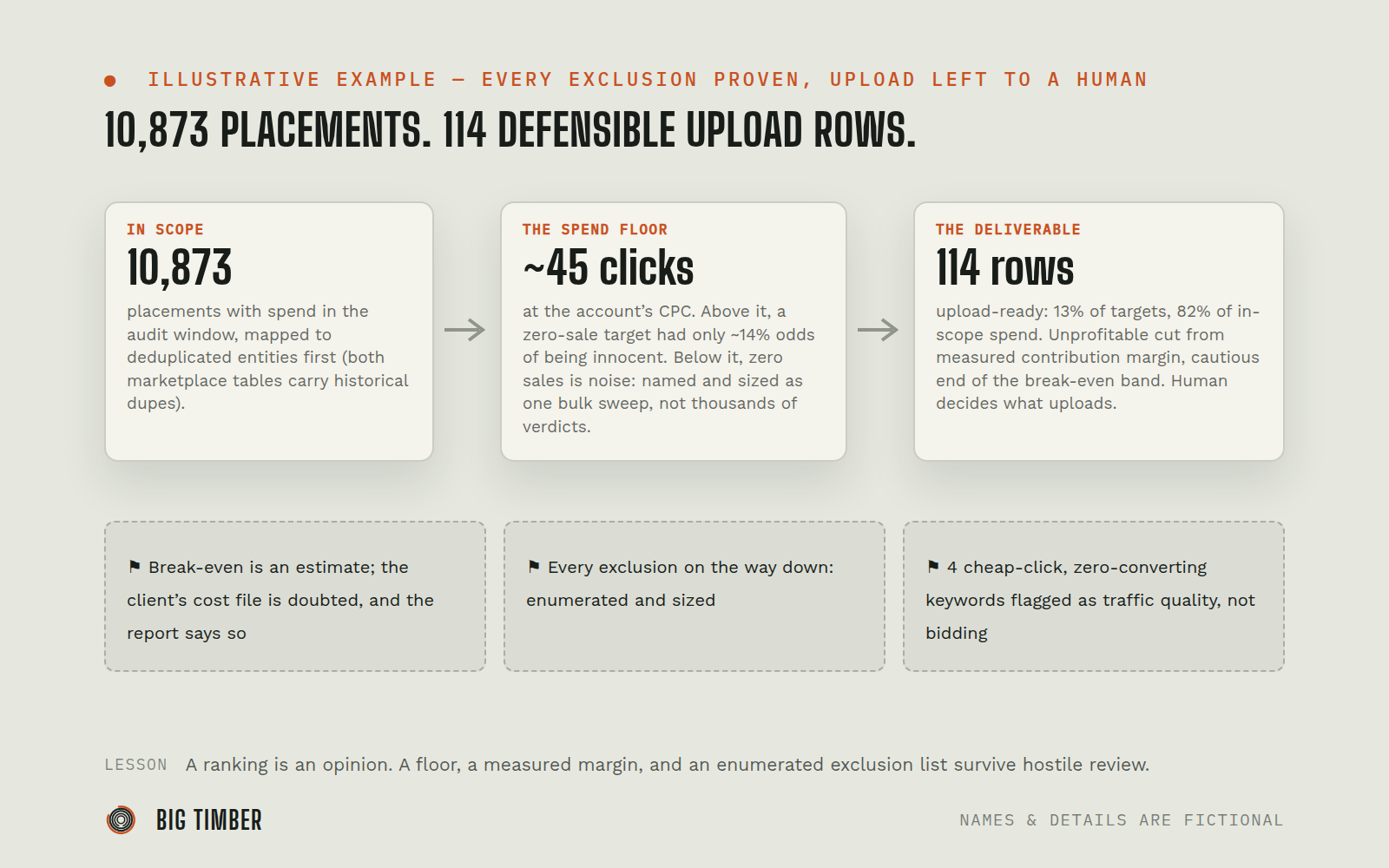
The floor landed at roughly 45 clicks at the account's cost per click: at the account's conversion rate, an average target has only about a 14% chance of showing zero orders across that many clicks, so "no sales" above the floor carries real information. Below it, zero sales is mostly noise.
- 02
Report what the floor hides instead of dropping it.
The sub-floor population, thousands of low-traffic targets mostly at zero sales, was named and sized as one bulk sweep decision rather than silently discarded or dressed up as thousands of individual calls.
- 03
Cut unprofitable targets on measured contribution margin.
The profitability line came from the account's measured economics, not a round ROAS target. And its weakest input was volunteered: the client's own cost file implies a margin the agent did not believe next to their other channels, and netting marketplace fees lands break-even across a wide band, so the cautious end was used and the report says plainly that the cut will move once someone confirms the real number.
- 04
Verify the entity mapping before acting on it.
Both marketplace tables involved carry historical duplicates, so the target-to-entity mapping was verified rather than trusted, preventing the same entity from being acted on twice under two identifiers.
- 05
Deliver upload rows and a standing procedure, not a mutation.
10,873 in-scope placements reduced to 114 upload rows covering 13% of targets and 82% of in-scope spend, with every exclusion on the way down enumerated and sized. One flag went out separately: a handful of keywords with thousands of clicks at a fraction of the account's usual cost per click and near-zero conversion, named as a traffic-quality question rather than a bidding one. The whole method shipped as a reusable procedure; the human decides what gets uploaded.
Evidence from the workflow.
Each system has a role.
intake (the in-scope population under audit)
Marketplace advertising target and placement data
signal (the contribution-margin inputs, with the doubted one named)
Client cost file and marketplace fee schedule
record of truth once verified (deduplicated before any action list)
Entity mapping tables
action (114 reviewable rows; the mutation stays with the human)
Upload-row deliverable + standing procedure
Why this is Coworker.
Takes assignments and reports back. You hand it work, it prepares and returns a result.
- 01
Read-only throughout; the deliverable is a reviewable upload file and the account is never modified by the agent. Every exclusion between the full population and the final rows is enumerated and sized in the report. Estimated inputs are labeled as estimates with their effect on the cut stated, and verified-over-trusted applies to entity mappings before any action list is built.
Impact / Outcomes
The action list covered 82% of in-scope spend with about 1% of the rows, because the floor and the cut were arguments rather than haircuts: nothing above the floor was excluded without being enumerated and sized.
The report's defensibility is the spend floor: above it, zero sales is evidence; below it, the report says so and recommends one bulk sweep instead of pretending to thousands of individual judgments.
The weakest input was volunteered before anyone could discover it: the break-even is an estimate on a doubted cost file, stated with the direction the cut moves when the real number arrives.
A traffic-quality anomaly (cheap clicks, collapsed conversion) was separated from the bidding question instead of being buried in the exclusion list, and the method persists as a reusable procedure for the next account.
Find where a workflow like this fits.
Start with the systems, work, constraints, and authority already present in your operation.