"Revenue Is Down 14%" Disproved in One Pass: Google Ads and Shopify Audit Finds a Broken Data Feed, Not a Broken Business
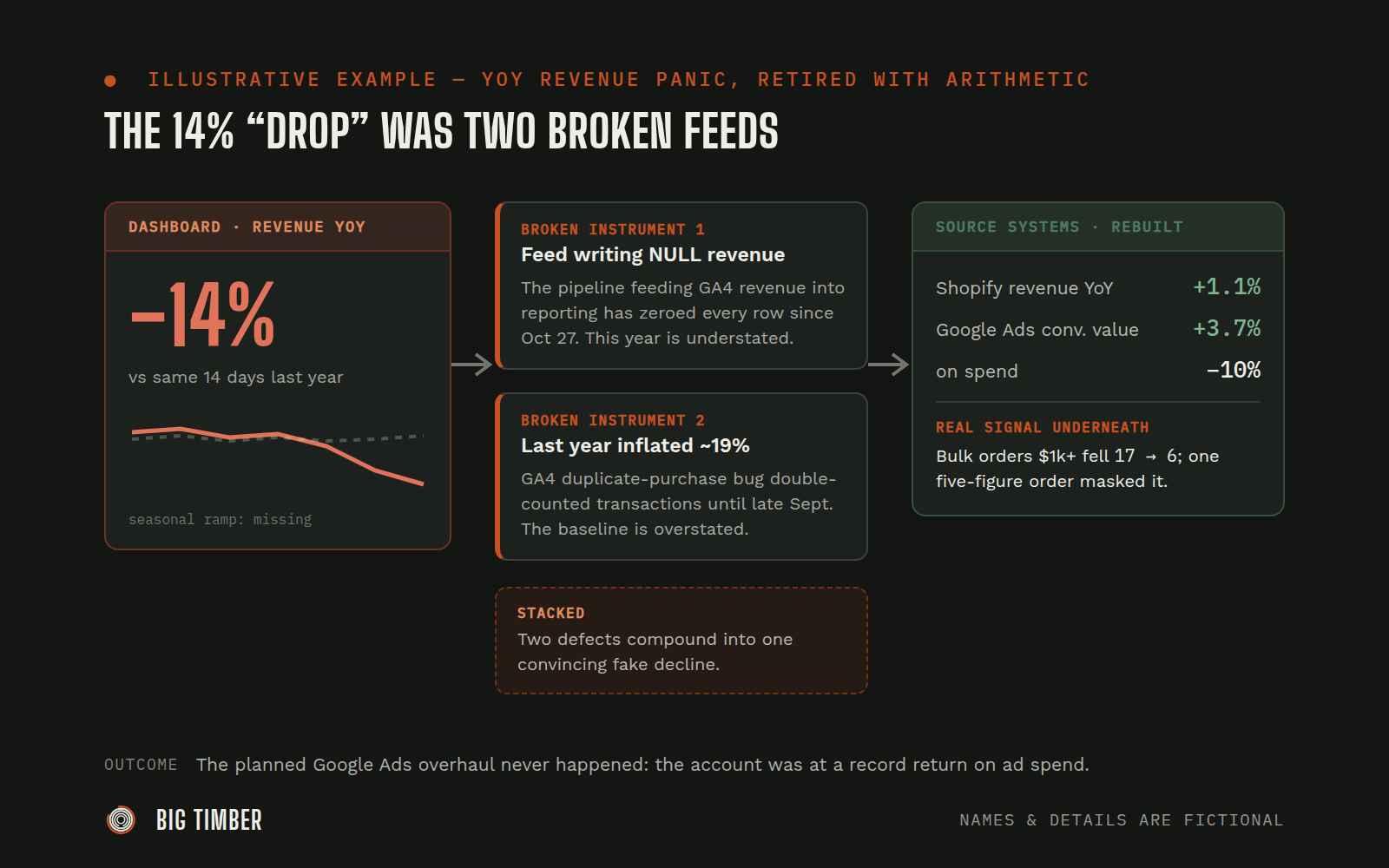
The dashboard said revenue fell 14% year over year. The source systems said it rose. The difference was two broken instruments stacked on top of each other.
What was getting in the way.
A year-over-year revenue chart drops 14% and the seasonal ramp everyone expects is missing. The instinctive response is expensive: cut the ad budget, overhaul the Google Ads account, demand answers from the agency. If the chart is wrong, every one of those moves damages a healthy business. Dashboards inherit the defects of every feed upstream of them, and when two defects stack (one deflating this year, one inflating last year) the result looks exactly like a real collapse. Nobody budgets a day of spreadsheet archaeology to double-check a chart that looks this unambiguous.
Context
An e-commerce retailer whose owner asked why revenue was down 14% year over year and where the seasonal ramp went. The pattern applies to any business where a dashboard disagrees with the till: the dashboard is a derivative, and derivatives inherit every upstream defect.
How the work runs.
- 01
Rebuild the number from source systems, not from the dashboard.
The agent pulls order-date revenue straight from Shopify and conversion-time value from Google Ads. Shopify shows revenue up 1.1% year over year; Google Ads shows conversion value up 3.7% on 10% less spend. Nothing is down.
- 02
Find the first broken instrument.
The reporting pipeline feeding GA4 revenue into the dashboard has been writing NULL into the revenue field for every row since a specific date about a week earlier. This year's line was missing its most recent days of revenue entirely.
- 03
Find the second broken instrument.
Last year's comparison figures were inflated roughly 19% by the known GA4 duplicate-purchase bug, which double-counted transactions until it was fixed in late September. This year was understated and last year was overstated, and the two defects compounded into a convincing fake decline.
- 04
Kill the follow-on false alarm while in there.
A separate "impression share collapsed from 45% to 20%" reading turned out to be a mix artifact: spend had shifted between Shopping campaigns and Performance Max, and within each campaign type impression share was flat.
- 05
Surface the real signal hiding underneath.
Bulk orders of $1,000 or more fell from 17 to 6 year over year, with one large five-figure order masking the decline in topline revenue. That is a real, specific, workable finding, and it has nothing to do with the ad account.
Evidence from the workflow.
Each system has a role.
record of truth (order-date revenue, the number dashboards should reconcile to)
Shopify
record of truth (conversion-time value, spend, impression share by campaign type)
Google Ads
the instruments under audit (the NULL feed and the duplicate-purchase inflation)
GA4 + reporting data pipeline
action (the verdict, the mechanism, and the real finding, delivered in one pass)
Team chat
Why this is Coworker.
Takes assignments and reports back. You hand it work, it prepares and returns a result.
- 01
All pulls are read-only against Shopify, Google Ads, and the warehouse. Every claim in the verdict is tied to a named mechanism and a reproducible query, so a human can re-check any line of it. The agent reports; humans decide what changes in the account and what is said to whom.
Impact / Outcomes
A planned remediation of the Google Ads account (cutting or overhauling it) was stopped before it started. The account was at a record return on ad spend and under-spending into the fourth quarter.
The 14% "drop" was fully explained by mechanism: a revenue feed writing NULLs since a known date, stacked on a prior-year baseline inflated by the GA4 duplicate-purchase bug. Both are checkable claims, not opinions.
The audit still produced a true problem to work: bulk orders of $1,000 or more fell from 17 to 6, a decline that topline revenue was hiding.
Minutes of agent work replaced a day of manual spreadsheet reconciliation, and the answer came with arithmetic attached.
Find where a workflow like this fits.
Start with the systems, work, constraints, and authority already present in your operation.