Google Ads Campaign Localized for a French-Speaking Market as a 173-Row Google Ads Editor CSV, From One Slack Request
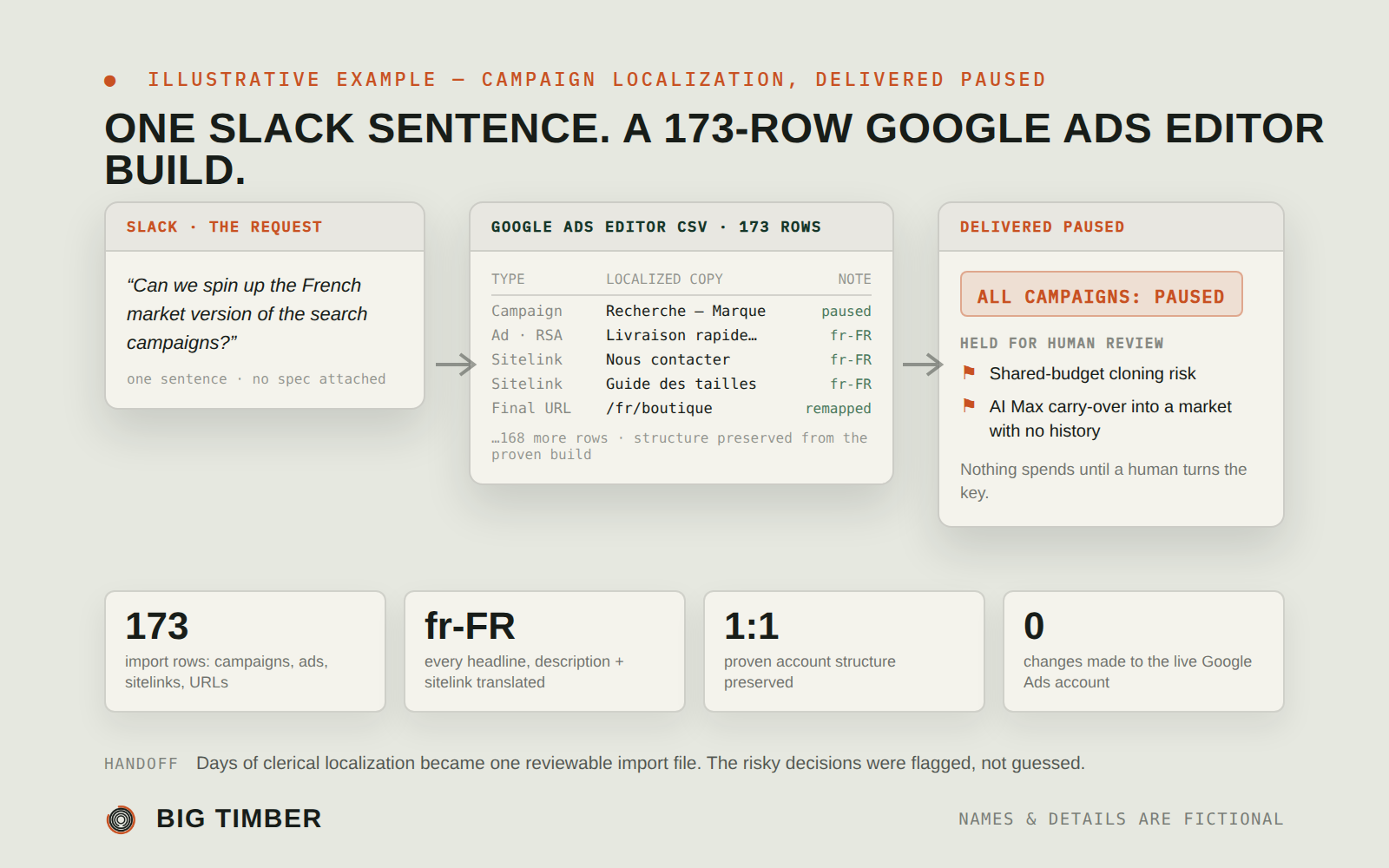
One Slack sentence became a complete, import-ready Google Ads Editor build for a new market: campaigns, translated ads, sitelinks, and final URLs, delivered paused, with the two genuinely risky decisions flagged for a human instead of guessed.
What was getting in the way.
Expanding a proven Google Ads account into a new language market is days of careful clerical work: clone the campaign structure, translate every headline, description, and sitelink without breaking character limits, remap every final URL, and rebuild settings. Done by hand it is slow and error-prone. Done carelessly by automation it is worse, because a bulk import that silently clones shared budgets or carries over automated settings like AI Max can start spending wrong money in a new market before anyone reviews it.
Context
A client expanding a performing Google Ads account into a French-speaking market. The pattern applies to any language or regional expansion of a proven paid-search build.
How the work runs.
- 01
Start from the proven structure, not a blank sheet.
The agent read the existing campaign build and preserved its structure in the localized version, so the new market inherits what already works instead of a fresh guess.
- 02
Translate the ads, the sitelinks, and the URLs together.
Headlines, descriptions, and sitelink text were translated for the French-speaking market and the final URLs remapped to the localized pages, keeping copy and destination consistent row by row.
- 03
Deliver as a Google Ads Editor CSV.
The build landed as a 173-row import file, the format a human can open, review line by line, and import in one pass, rather than as changes pushed straight into the live account.
- 04
Ship it paused.
Every campaign in the import arrives paused. Nothing can spend until a human turns it on.
- 05
Flag the risky carry-overs instead of resolving them silently.
The agent named two decisions for human review: the shared-budget cloning risk (a budget object cloned into a new market can couple spend in ways the structure hides) and the AI Max carry-over question (whether the automated feature should be active in a brand-new market with no history). Both were handed off, not guessed.
Evidence from the workflow.
Each system has a role.
intake (the one-sentence request)
Slack
record of truth (the proven source campaign structure)
Google Ads
the deliverable (173 import-ready rows: campaigns, ads, sitelinks, URLs)
Google Ads Editor CSV
signal (final URL remapping targets)
Localized site pages
Why this is Coworker.
Takes assignments and reports back. You hand it work, it prepares and returns a result.
- 01
The agent never touched the live Google Ads account. The deliverable is a reviewable file; campaigns arrive paused; and decisions with spend consequences are flagged by name for human sign-off. The handoff boundary is explicit: the agent ships work hot, the human owns activation.
Impact / Outcomes
Days of clerical campaign-localization work compressed into one agent pass, delivered in the exact format (Google Ads Editor import) the account team already trusts for review.
The import arrived paused with structure preserved, so review happened on a complete artifact instead of a half-built account.
The two decisions that could have spent money wrongly, shared-budget cloning and AI Max carry-over, reached a human as named flags before import instead of surfacing as surprises after launch.
Find where a workflow like this fits.
Start with the systems, work, constraints, and authority already present in your operation.