Conversion Tracking Fell to Zero Overnight: Diagnosed as a Dead Tag, Not a Dead Business, Before Automated Bidding Starved the Account
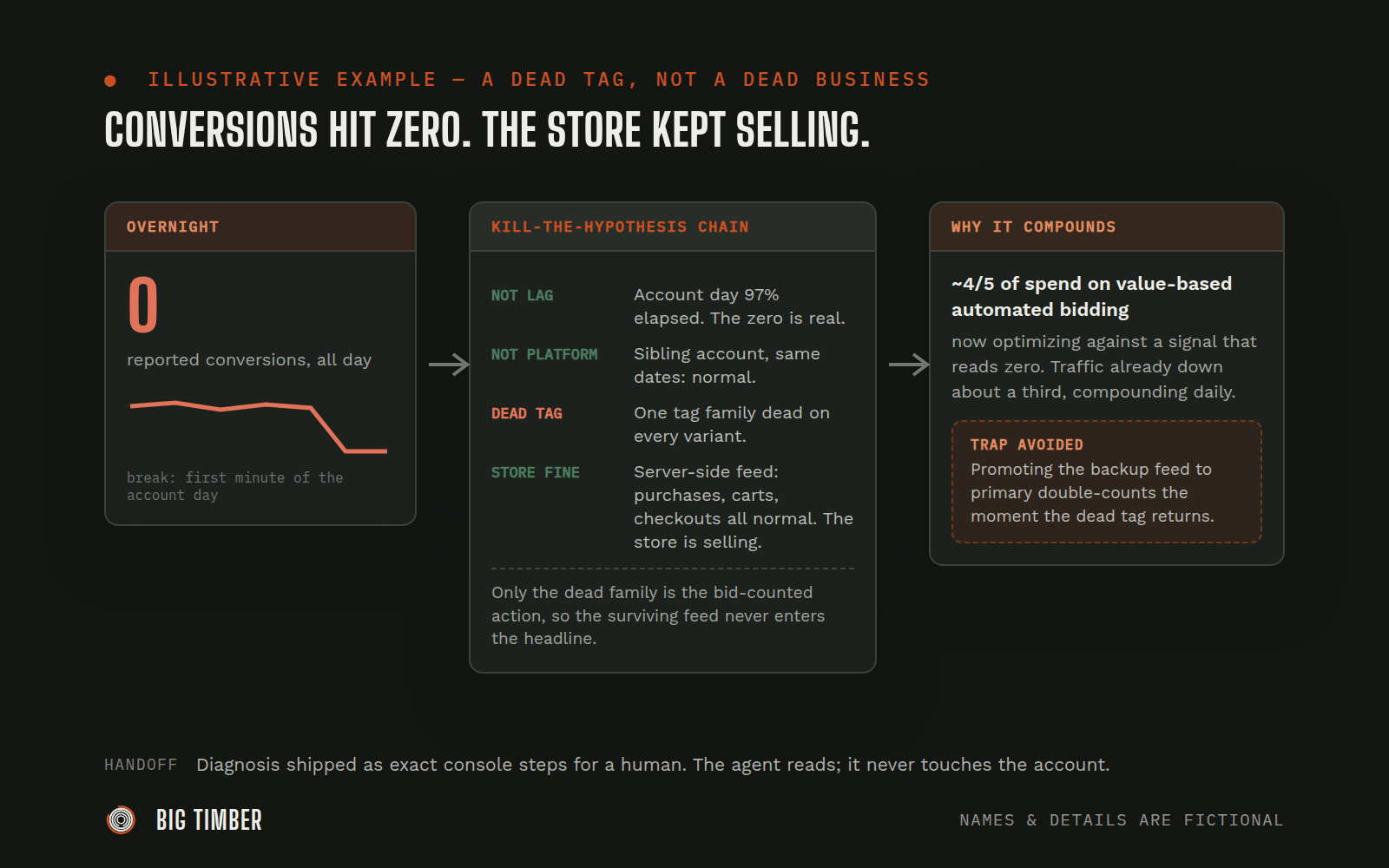
Reported conversions hit zero overnight while the store kept selling. The agent walked a kill-the-hypothesis chain to the real cause, a dead conversion tag starving value-based automated bidding, and handed a human the exact console checks, plus the one tempting fix that would have double-counted later.
What was getting in the way.
When an ad account's reported conversions fall to zero overnight, every explanation is expensive and most are wrong. Treat it as a business collapse and you cut spend on a healthy store. Treat it as reporting lag and you wait while the real damage compounds: on accounts running value-based automated bidding, the bidding system is optimizing against the zero in real time, throttling traffic harder each day. And the obvious quick fix, promoting a surviving backup tracking feed to primary, quietly plants a double-counting bug that detonates the day the dead tag comes back.
Context
An e-commerce ad account where most spend runs on value-based automated bidding. The ad platform and tag vendors are deliberately not named in this entry; the source record scrubs vendor identifiers, and the pattern applies to any ad platform where a bid-counted conversion action can die while a parallel feed survives.
How the work runs.
- 01
Rule out reporting lag with the account's own clock.
The account's local timezone put the current day about 97% elapsed, so a zero was not a partial-day artifact. First alternative dead.
- 02
Rule out a platform-wide problem with a control.
A sibling account on the same ad platform over the same dates was entirely normal. Not the platform. Second alternative dead.
- 03
Break the metric down to the action level.
One vendor's conversion tag family was dead across every single variant, while a parallel server-side tracking feed in the same account kept recording purchases, carts, and checkouts at normal volume. The store was up and selling. The headline read zero because only the dead tag family was flagged as the bid-counted conversion action, so the surviving feed never entered the reported metric at all.
- 04
Time the break and size the blast radius.
The failure began in the first minute of an account day, near-instant rather than gradual, pointing at a change, not a decay. Roughly four fifths of recent spend sat on value-based automated bidding that was already throttling against the zero signal: traffic was down about a third and compounding daily. That is what made it urgent rather than interesting.
- 05
Hand off the fix with the trap labeled.
Read-only access is permanent on this deployment, so the recommendation went out as exact human steps in the two vendor consoles. Two caveats traveled with it: do not read reported conversion value as revenue for the affected days, and do not promote the surviving feed to primary, because the moment the dead tag returns, every sale counts twice.
Evidence from the workflow.
Each system has a role.
the surface under diagnosis (the zero that started it)
Ad platform conversion reporting
signal (the dead instrument and the surviving control)
Conversion tag family and server-side tracking feed
the blast radius (optimizing against a signal reading zero)
Value-based automated bidding
action (the two human checks that end it; agent is read-only by design)
Vendor consoles
Why this is Coworker.
Takes assignments and reports back. You hand it work, it prepares and returns a result.
- 01
The agent's access is read-only by construction; every remediation step was delivered as instructions for a human in the vendor consoles. Each step of the diagnosis was built to falsify the hypothesis, and the caveats (do not trust reported value for affected days, do not promote the backup feed) shipped with the diagnosis rather than after it.
Impact / Outcomes
A tracking failure was cleanly separated from a business failure in one diagnostic pass, before anyone cut budget on a store that was selling normally.
The compounding cost was named and sized: most of the account's spend sat on automated bidding that was throttling daily against a false zero, with traffic already down about a third.
The tempting wrong fix was prevented in advance: promoting the backup feed would have double-counted conversions the moment the dead tag revived, a defect that would have surfaced weeks later as unexplained inflation.
The human got console-level instructions, not a vague alert, so the fix took minutes of the right person's time.
Find where a workflow like this fits.
Start with the systems, work, constraints, and authority already present in your operation.