Cloudflare Cache HIT Ratio Low? AI Audit Traces 72% MISS Rate to Datacenter Hopping, Not a Misconfiguration
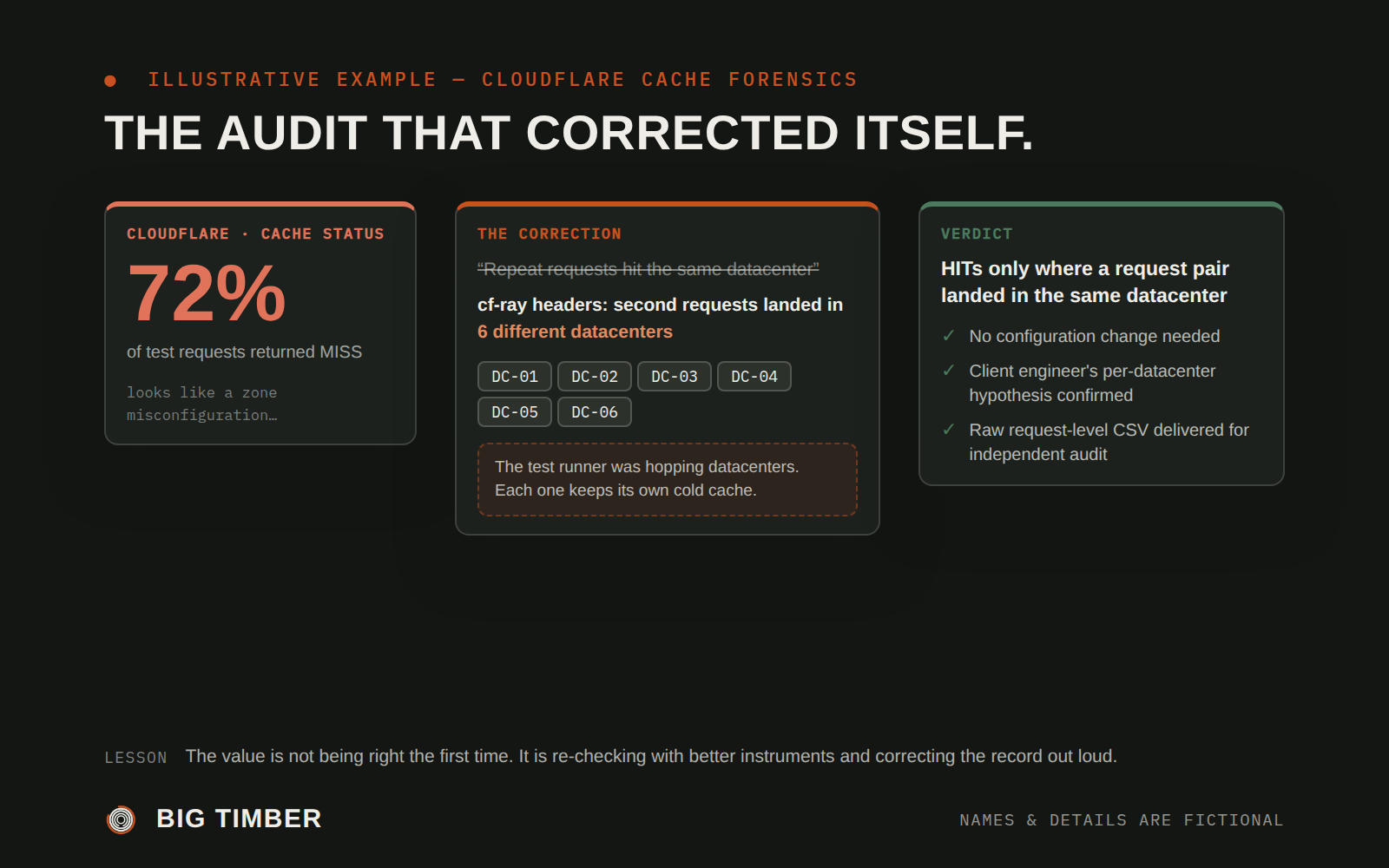
A 72% cache MISS rate looked like a CDN misconfiguration. The first analysis blamed the wrong thing. The agent re-ran it, corrected itself in writing, and the real explanation matched the client engineer's hypothesis.
What was getting in the way.
A client engineer asks why the CDN cache MISS rate is so high before a launch. Cache behavior on a global CDN is genuinely confusing: whether a repeat request HITs depends on which datacenter it lands in, and test tools quietly hop between datacenters. It is easy to run a shallow test, draw a confident wrong conclusion, and send the client chasing a zone misconfiguration that does not exist. Worse, once a wrong claim is in a client-facing thread, most workflows quietly bury it rather than correct it.
Context
A client engineering team asking hard performance questions before a site cutover. The pattern applies anywhere an AI agent's first answer might be wrong: the value is not infallibility, it is re-checking with better instruments and correcting the record out loud.
How the work runs.
- 01
Re-run the test with full headers captured.
Paired requests to the same URLs, recording the cf-ray header that names the exact Cloudflare datacenter serving each response.
- 02
Catch the earlier error.
The first analysis had claimed repeat requests landed in the same datacenter. The cf-ray data showed second requests spanning six different datacenters. The prior claim was wrong, and the correction was written down as a correction, not silently replaced.
- 03
Explain the MISS rate with the corrected data.
Cache HITs appeared only where a request pair happened to land in the same datacenter. The high MISS rate was largely the test runner hopping between datacenters, each with its own cold cache, not a zone misconfiguration.
- 04
Score the hypotheses.
The result supported the client engineer's per-datacenter caching hypothesis and retired the misconfiguration theory the earlier analysis had implied.
- 05
Hand over the raw data.
The full request-level CSV (URLs, datacenters, cache statuses, ages) went to the client with the write-up, so the conclusion could be audited rather than trusted.
Evidence from the workflow.
Each system has a role.
record of truth (cf-ray datacenter codes, cache status headers, age headers)
Cloudflare
the instrument under audit (paired requests, header capture)
HTTP test harness
action (the correction, the explanation, and the raw CSV delivered together)
Team chat + document pipeline
Why this is Coworker.
Takes assignments and reports back. You hand it work, it prepares and returns a result.
- 01
All tests are read-only HTTP requests against the published site. Every claim maps to rows in the delivered CSV. Corrections to prior analysis are stated as corrections. A human reviewed the write-up before it reached the client.
Impact / Outcomes
The 72% MISS rate was explained by mechanism: test requests spread across six datacenters, with HITs only on same-datacenter pairs. No configuration change was recommended because none was needed.
The earlier wrong claim was corrected explicitly in the client-facing write-up, preserving trust instead of spending it.
The client engineer's hypothesis was confirmed with data rather than deference, and the raw CSV let their team verify every row.
A planned round of cache-rule tinkering was avoided, and attention moved to the real pre-launch work: cache warming for the cutover.
Find where a workflow like this fits.
Start with the systems, work, constraints, and authority already present in your operation.