One Sentence of Feedback Becomes a Permanent Publishing Gate in the Content Build Pipeline
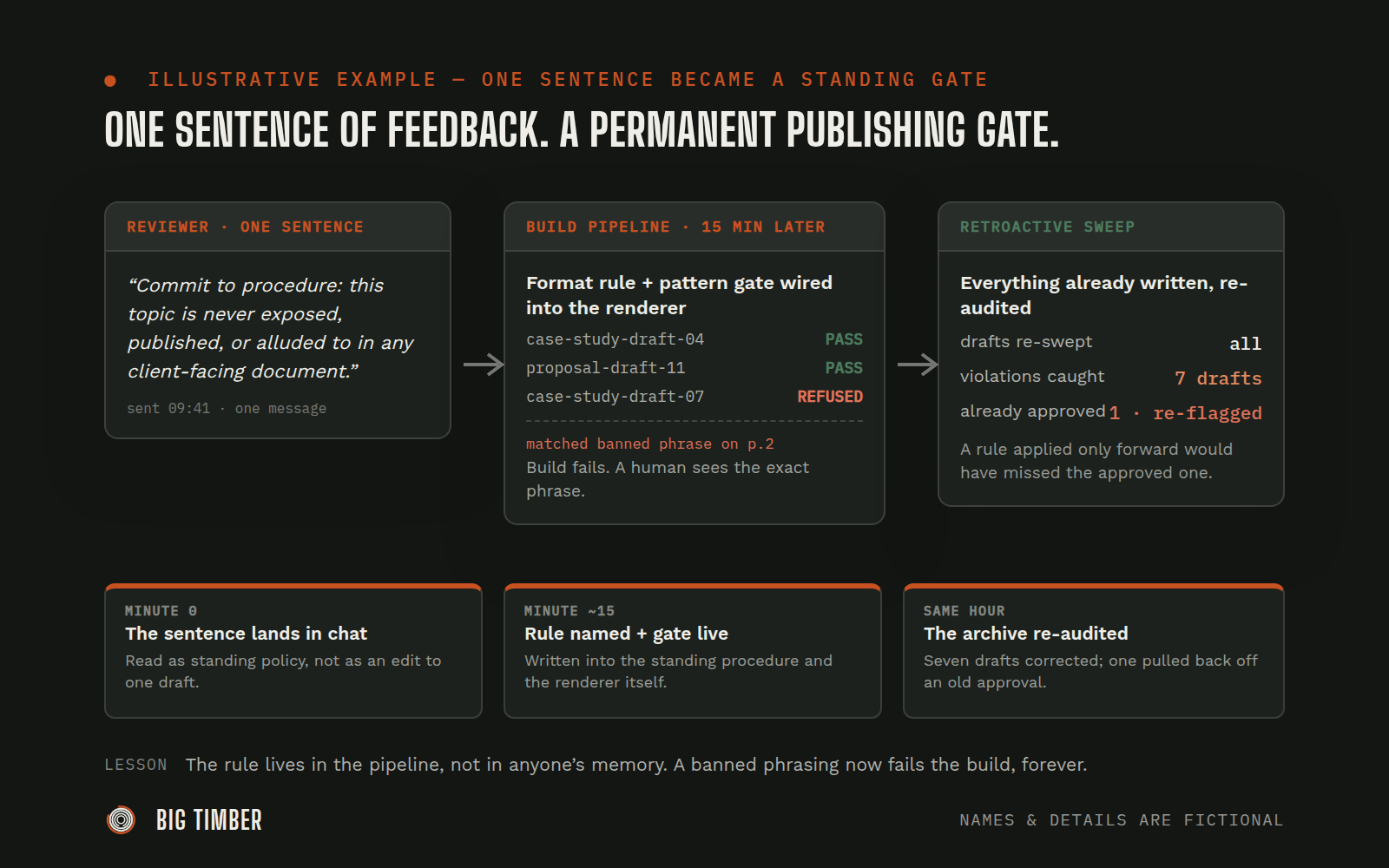
A reviewer wrote one sentence of standing policy. Fifteen minutes later it was a rule the build system enforces on every future draft, and a sweep had already caught one approved document that violated it.
What was getting in the way.
Editorial standards communicated in chat have a half-life. A reviewer says "never phrase it this way" once, the current draft gets fixed, and three weeks later a new draft makes the same mistake because the rule lived in one person's memory and one scrolled-past message. The worst version is a standing confidentiality rule: a sentence that must never appear in any published document, enforced by nothing except everyone remembering it forever. Human memory is not a compliance system.
Context
Universal. The pattern applies to any standing editorial, legal, or confidentiality rule in any content pipeline: case studies, proposals, published pages, client reports.
How the work runs.
- 01
Treat the feedback as policy, not as an edit.
The reviewer wrote one sentence of standing policy about a topic that must never be exposed, published, or alluded to in client-facing documents. The agent read it as a permanent rule for all future output, not as a correction to the draft at hand.
- 02
Write the rule down where rules live.
Within minutes the sentence became a named format rule in the standing procedure, so the next writer (human or agent) inherits it without anyone re-explaining it.
- 03
Wire the rule into the build, not the checklist.
The agent added a pattern gate to the document renderer itself: any draft containing the banned phrasings now fails the build. A rule enforced at build time cannot be forgotten, skipped, or approximated under deadline pressure.
- 04
Re-audit everything already written.
The agent swept all existing drafts against the new rule. The sweep caught violations in seven drafts, including one document that had already been approved, which was pulled back and re-flagged rather than left to ship on an old approval.
- 05
Report the enforcement, not just the fix.
The reviewer got back more than an edited draft: a named rule, a build gate that proves itself on every future render, and the list of existing documents the sweep caught and corrected.
Evidence from the workflow.
Each system has a role.
intake (the one sentence of reviewer feedback)
Team chat
action (the pattern gate that fails any draft containing banned phrasings)
Document build pipeline
record of truth (the standing format rule the next writer inherits)
Agent procedure library
signal (the re-audit sweep across everything already written)
Draft archive
Why this is Operator.
Owns a workflow end to end, running the process inside the authority you set.
- 01
The gate blocks and reports; it never silently rewrites. A draft that fails the gate goes back to a human with the exact matched phrase named. The rule's wording came from the reviewer verbatim and is recorded with its origin, so the policy stays auditable and revocable by the human who set it.
Impact / Outcomes
One sentence of chat feedback became a permanent, self-enforcing publishing rule in about fifteen minutes, with no meeting, no style-guide revision cycle, and no reliance on anyone remembering it.
The re-audit caught a violation in an already-approved document before it published. A rule applied only going forward would have missed it.
The rule now enforces itself at build time: a banned formulation fails the render, so compliance stopped being a memory problem and became a property of the pipeline.
Find where a workflow like this fits.
Start with the systems, work, constraints, and authority already present in your operation.