"Build It" Turned Out to Be an API Approvals Project: Four Platform Access Reviews Audited Before Writing Code
Asked to start building a product on Lovable, the agent first verified what the four platforms it would connect to actually allow. The build was never the critical path. The approval clocks were, and one wrong move would have burned a quota that can never be reset.
What was getting in the way.
"Just build it" is how integration projects usually start, and the platform paperwork is discovered afterward, in the worst order: after the code works, after the demo, sometimes after launch. API platforms change their access rules constantly. A developer-token program gets deprecated, an app-review queue has no published turnaround, and some limits are permanent: one platform caps unverified apps at a lifetime total of users that can never be reset, so burning it on test users is irrecoverable. Code written before those facts is code written toward a wall.
Context
Universal. The pattern applies to any product or internal tool that connects to third-party APIs: the platform's approval process is part of the build, and it is usually the longest part.
How the work runs.
- 01
Read the platforms' own documents, not summaries.
For each of the four platforms the product would connect to, the agent verified the current access model against primary documentation: what kind of app registration, what review process, what usage limits, what has changed recently.
- 02
Find the deprecation before it finds the project.
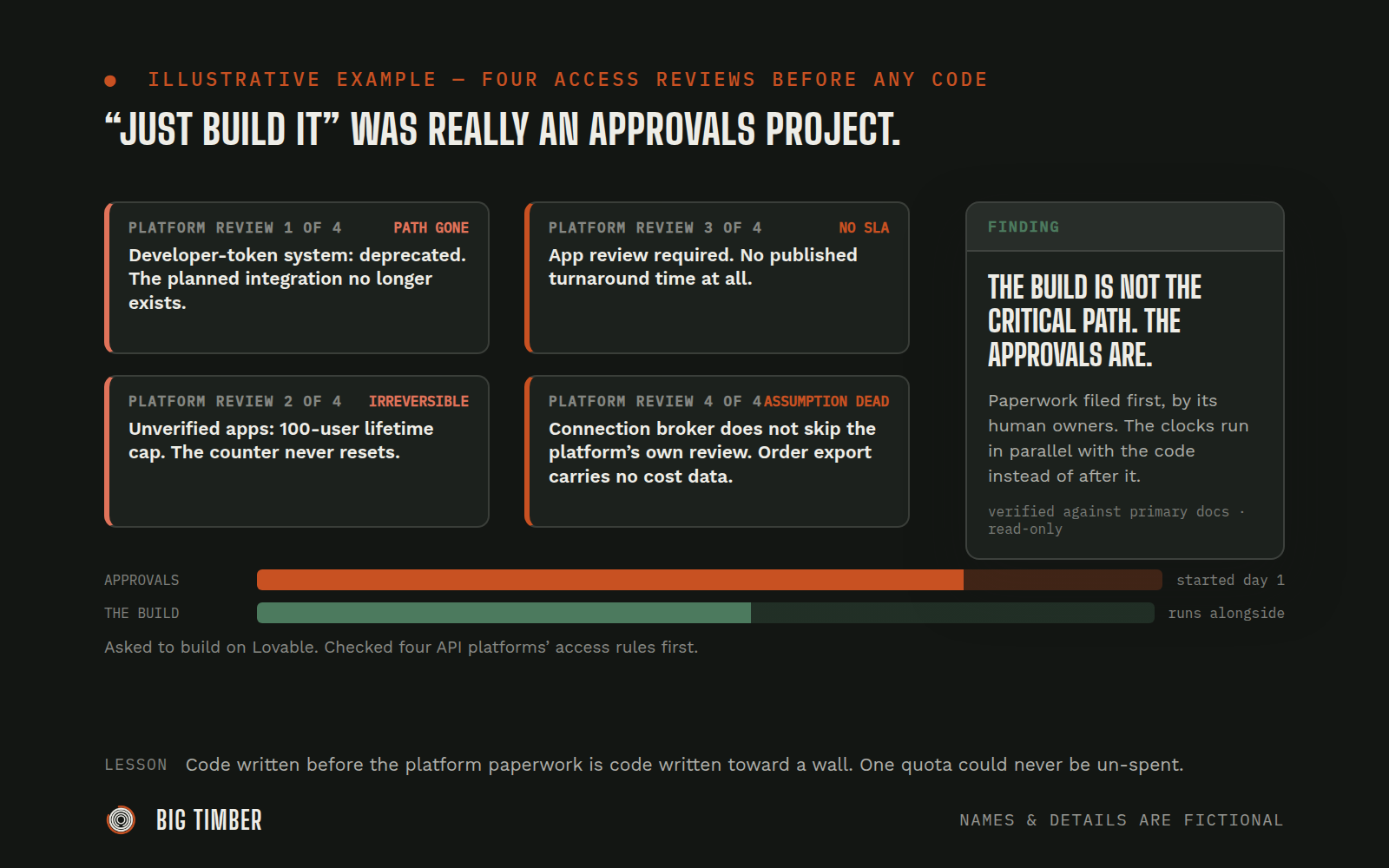
One platform had deprecated the developer-token system the build plan assumed. The planned integration path did not exist anymore.
- 03
Find the irreversible limit before spending it.
Another platform caps unverified apps at a lifetime total of one hundred users, and that counter never resets. A casual test rollout would have permanently consumed the quota the real product needed.
- 04
Kill two convenient assumptions by checking them.
A third-party connection broker did not remove the platform's own app-review requirement, and a commerce platform's order export carried no cost data. Both assumptions would have shaped the build wrongly.
- 05
Reorder the project around the clocks.
Two of the four reviews had no published turnaround time at all. The agent's finding: the build is not the critical path, the four independent platform trust reviews are, and the paperwork a human owns should start immediately so the clocks run in parallel with the code instead of after it.
Evidence from the workflow.
Each system has a role.
record of truth (the access rules verified at the source)
Platform developer documentation
action (the hosted build platform the product would be built on)
Lovable
the surface under audit (tokens, verification tiers, user caps, review queues)
OAuth app registrations and review programs
the deliverable (reordered so approvals start before the build)
Project plan
Why this is Coworker.
Takes assignments and reports back. You hand it work, it prepares and returns a result.
- 01
All verification was read-only against public primary documentation. The agent changed the plan, not the platforms: filings and review submissions stayed with their human owners, with the findings and the recommended order on the record.
Impact / Outcomes
A deprecated integration path and a permanently non-resettable user cap were both discovered before any code existed, instead of after a test rollout had consumed the quota.
Two load-bearing assumptions (a broker bypassing review, cost data in an export) were falsified by reading primary sources, redirecting the design before it hardened.
The project was re-sequenced on evidence: approval paperwork with unpublished turnaround times started first, so the slowest clocks run in parallel with the build instead of being discovered behind it.
Find where a workflow like this fits.
Start with the systems, work, constraints, and authority already present in your operation.