The Agent That Retracted Its Own "Resolved" the Next Day, Instead of Letting the Record Stand
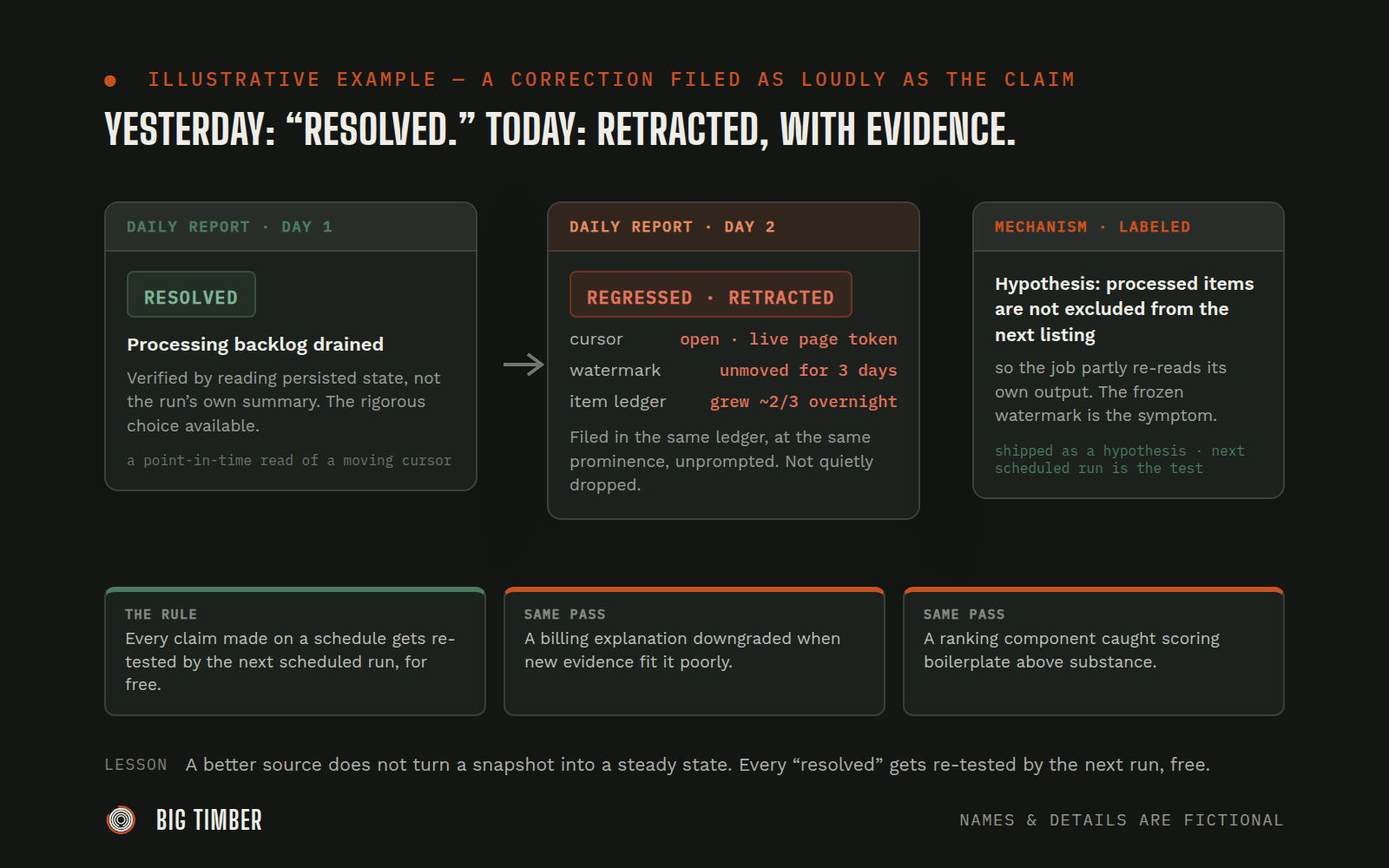
Yesterday's report said the backlog had drained, verified against persisted state, not a summary line. Today's scheduled review found the cursor open, the watermark frozen for three days, and the ledger still growing. The report filed itself as regressed, in writing, unprompted.
What was getting in the way.
Status reports rot in one direction. "Resolved" gets written once and never re-examined, because nobody is assigned to disprove last week's good news. Automated systems make this worse: a job's state can look drained at the moment you read it and be refilling an hour later, and the human record keeps saying fixed. The failure is not dishonesty. It is that a snapshot got promoted to a steady state, and no process ever went back to check.
Context
Universal. Any organization with automated status reporting, agent retrospectives, or standing dashboards accumulates "resolved" claims nobody is assigned to disprove; this pattern makes the next scheduled run the assigned disprover.
How the work runs.
- 01
Make the original claim the careful way, which is the point.
The prior day's report called a processing backlog drained, verified by reading the persisted state file rather than trusting the run's own summary line. That was the rigorous choice available, and it was still wrong, because it was a point-in-time read of a moving cursor.
- 02
Let the next scheduled review re-test old claims, not just report new work.
The following day's review read the same state again: cursor open with a live page token, the progress watermark unmoved for three days, and the item ledger grown by roughly two thirds. The "drained" claim was dead on arrival.
- 03
File the regression where the resolution was filed.
The standing report's ledger recorded it plainly: resolved, none; regressed, one, the item reported resolved yesterday, retracted rather than quietly dropped. The retraction got the same prominence the good news had.
- 04
Diagnose the mechanism, not just the reversal.
The run's own notes flagged that the work queue grew on a later pass, with a stated hypothesis: already-processed items were not being excluded from the next listing, so the job was partly re-reading its own output and the frozen watermark was the symptom. The hypothesis shipped labeled as a hypothesis.
- 05
Extract the rule that prevents the class.
Two more self-corrections landed in the same pass (a billing explanation downgraded when new evidence fit it poorly, and a ranking component caught scoring boilerplate above substance). The standing lesson went into the record: a better source does not turn a snapshot into a steady state, and anything on a schedule gets its claims re-tested by the next run for free.
Evidence from the workflow.
Each system has a role.
record of truth (cursor, page token, watermark, ledger: the evidence both days)
Persisted job state
action (the pass that re-tests yesterday's claims)
Scheduled daily review
the deliverable (resolved and regressed carry equal weight, with history preserved)
Standing report ledger
signal (the mechanism hypothesis, labeled as such)
Run notes
Why this is Operator.
Owns a workflow end to end, running the process inside the authority you set.
- 01
Corrections are append-only: the original claim, the contradicting evidence, and the retraction all stay visible in sequence, never overwritten. Regressions get equal ledger weight with resolutions, and unverified mechanisms ship labeled as hypotheses with the test the next run will perform.
Impact / Outcomes
A false "resolved" lived for exactly one day instead of indefinitely, caught by the system's own next scheduled pass rather than by a human stumbling onto the symptom weeks later.
The retraction was filed with the same prominence as the original claim, so the record reads true in sequence: anyone auditing it sees the claim, the evidence that killed it, and the correction, in order.
The diagnosis separated the reversal from its mechanism and labeled the mechanism a hypothesis, so the next run tested a specific prediction instead of a vibe.
The reporting rule generalized: snapshot reads of moving systems are treated as snapshots, and every scheduled claim now has a built-in re-test, the next run.
Find where a workflow like this fits.
Start with the systems, work, constraints, and authority already present in your operation.