Self-Improving AI Agent: How OpenClaw Learns From Its Own Work
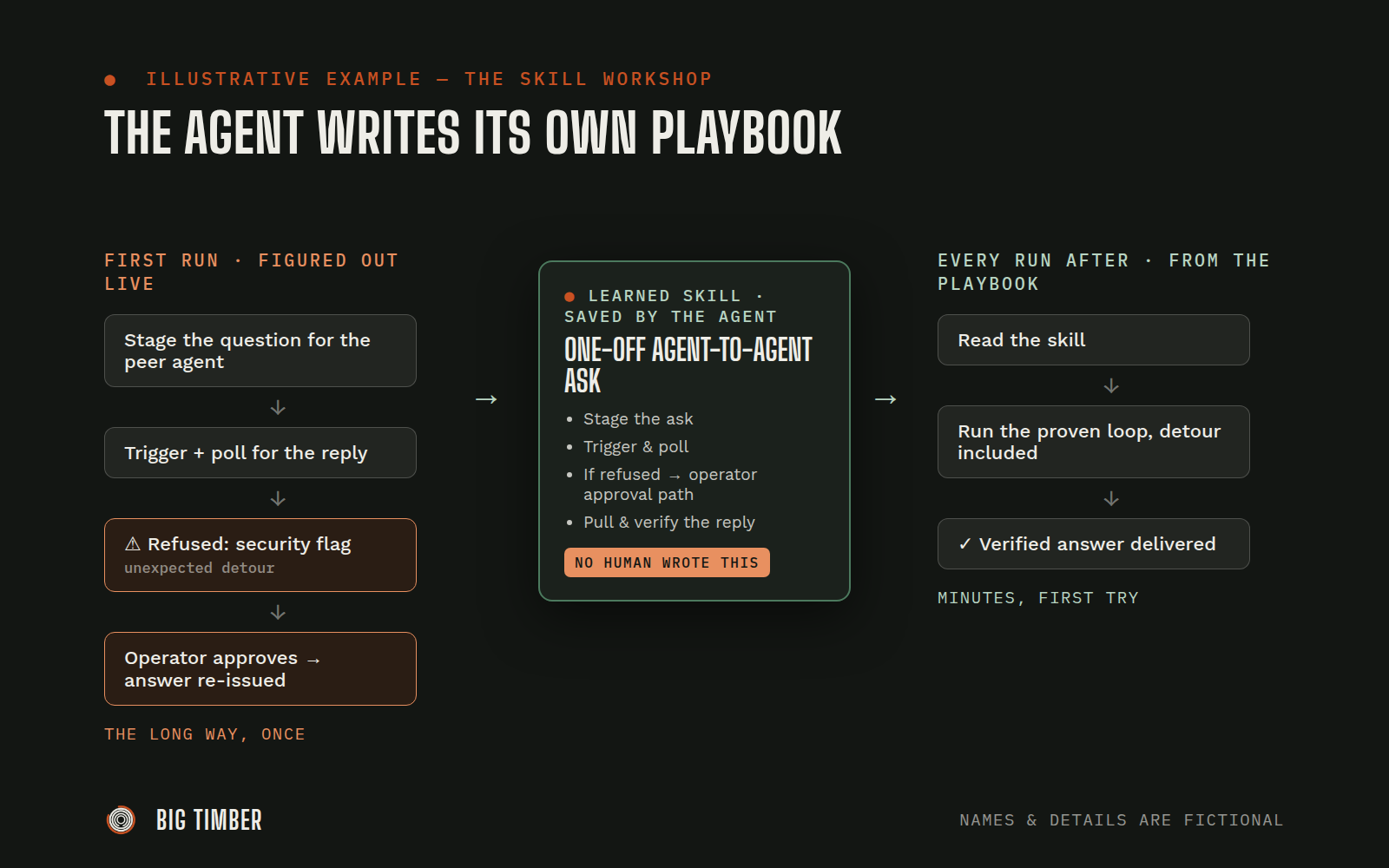
Most AI tools have the memory of a goldfish. You walk one through a tricky multi-step task today, and tomorrow it starts from zero: same questions, same dead ends, same billable time spent re-deriving a procedure it already figured out once. A self-improving AI agent closes that loop. OpenClaw ships with a built-in capability we call the skill workshop: when the agent finishes a hard, multi-step task that it is likely to see again, it writes the working procedure down as a learned skill. Next time, it reads its own playbook instead of reinventing it.
What a learned skill actually is
A learned skill is a short, structured procedure the agent authors for itself: the goal, the steps that worked, and, most importantly, the traps it hit along the way and how it got out of them. It is not a transcript and it is not a vague summary. It is the distilled "here is exactly how to do this next time," written by the one who just did it.
You do not manage any of this from a console. You ask for work in Slack or Microsoft Teams, the agent does it, and the learning happens behind the scenes.
How the loop runs
- Do the work. The agent completes a genuinely hard task: multiple steps, real obstacles, judgment calls.
- Recognize the repeat. If the task is something the business will need again, that is the trigger. One-off trivia does not get saved; recurring procedures do.
- Write it down. The agent saves the working procedure, including the edge cases, into its skill library.
- Reuse it. The next time a matching task shows up, the agent reads the skill first and executes: minutes instead of a fresh investigation.
- Patch it. If a saved skill turns out to be wrong or incomplete on a later run, the agent fixes that step. Every change keeps the previous version, so a human can review or roll anything back.
A real example
One of our deployed agents needed to send a one-off research question to a peer agent running on another company's box, a formal agent-to-agent exchange. The task had real teeth: staging the question as a structured request, triggering the other agent, polling for the reply, and pulling it back. Midway through, the peer agent refused to answer. Its security rules flagged the question, and the correct path turned out to be an operator-approved rewrite: a human on the other side reviews, approves, and the peer agent reissues its answer.
That whole dance, including the refusal-and-approval detour, is now a saved skill. The next ask runs the proven loop on the first try: no rediscovering the refusal path, no guessing at the handshake. We have written before about how far this pattern extends; agents can even transfer skills to each other across deployments.
How skills work without this
Skills as a concept are not unique to OpenClaw. Most serious agent platforms now support some version of them: a folder of instruction files the agent can consult, each one describing how to perform a specific job. They work, and they are a big part of why agents have become reliable enough for real business tasks.
The catch is who writes them. On most platforms, a skill exists because a person sat down and codified it. Someone has to notice that a task keeps recurring, remember how it was solved, write the procedure out in the format the platform expects, test that the agent actually follows it, and then maintain the file as tools and processes change. That is real work, and it lands on whoever in the company is most fluent with the AI. In practice it becomes a part-time job: the unofficial "agent librarian" who owns a growing folder of hand-written procedures. When that person is busy or gone, the library goes stale, and the agent quietly gets dumber relative to the business around it.
OpenClaw keeps the same skill architecture but moves the authorship. The agent that just did the work writes the skill, because it is the only party that knows exactly which steps mattered and which detours were load-bearing. Humans stay in the loop as editors, not authors: every skill is readable in plain language, every revision is versioned, and an owner can say "undo that" and the previous version comes back.
Why this is ideal for business deployment
This is the part that matters if you are the one signing off on an AI rollout: your team does not need to learn what a skill is.
Nobody attends a training session on skill authoring. Nobody maintains a prompt library. Nobody is assigned to "keep the AI's documentation current." Your people just ask for work in the channels they already use, the same way they would ask a capable coworker. The agent handles the task, and when the task was hard and repeatable, the agent teaches itself. The institutional knowledge accumulates as a side effect of doing the job.
Compare that to the standard deployment story: buy licenses, schedule enablement sessions, nominate champions, and hope the prompt guide on the shared drive survives its author's next role change. Most of that ceremony exists to compensate for tools that cannot retain what they learn. Remove the limitation and the ceremony goes with it. (Related: how AI agent memory works.)
There is a compounding effect too. Week one, the agent is figuring things out. Month three, a meaningful share of incoming requests match a skill it already owns, and those tasks run faster, cheaper, and with fewer errors than the first attempt ever did. The agent you have in month six is measurably more useful than the one you deployed, and nobody on your team spent an hour making that happen.
It is the difference between hiring a contractor who forgets your building every night and an employee who knows where the breaker panel is. Except this employee also writes the manual, keeps it current, and hands you the revision history.