Why We Run Three AI Models, Not One (And When Each Takes Over)
Think of your delivery address with three different carriers set up: UPS, FedEx, and USPS. If UPS is on strike today, the shipment doesn't just sit on the dock — it goes to FedEx. The box still arrives. The person waiting for it has no idea which truck brought it.
That's a model fallback. In an AI system, the "carriers" are different AI models — made by different companies (Anthropic, OpenAI, Google), each with their own strengths, limits, and occasional bad days. A fallback is the plumbing that says: if the first one can't do the job right now, hand it to the second one. If that one can't either, go to the third. The customer sees "the AI answered my question." They don't see that three different brains were on standby.
The babysitter list
Imagine your kid has three babysitters on the fridge: Aunt Jane, Grandma, and the neighbor Mia. Aunt Jane is your first call — she knows the routine, the kid loves her. But sometimes Aunt Jane is on a plane. So you call Grandma. Grandma's great too, slightly different style, but the kid is fed and in bed on time. If Grandma is at her bridge club, you call Mia — younger, newer, but she's reliable and she's five minutes away.
Nobody is better than everyone at everything. Nobody is available 24/7. The list, in order, is what keeps the kid covered. Your AI agent needs the same list.
Why one AI model is a problem
Here's what breaks when a business bets everything on one model.
- Rate limits. Every AI company caps how much you can use at once. Hit the cap on a busy Tuesday morning and your agent stops working — mid-task, no warning, right when the leads are coming in.
- Outages. Every AI company goes down. Anthropic, OpenAI, and Google all have outages measured in minutes to hours — different days, different hours, almost never at the same time.
- The task isn't a fit. The best model for a warm follow-up email is not the best model for parsing a 200-row CSV. The best model for coding is not the best model for headlines. If your "one AI" is forced to do everything, you get mediocre at the stuff it's bad at.
- Price spikes. Model pricing shifts. A model that was cheap in January can be expensive in October. If you're hard-wired to one, you take whatever bill arrives.
Any one of those will interrupt your business. All four of them will happen in a year.
How the fallback actually works
A plain-English picture of what runs when a task comes in.
- Try the preferred model first. For most of our agents, that's Claude (Anthropic). It handles nuance, follows instructions, and holds a long conversation well.
- If it fails, retry on the backup. Rate-limited? Timeout? API error? The task is handed to GPT (OpenAI) with the same instructions. No human notified yet — this happens in under a second.
- If the backup also fails, go to the third. Gemini (Google) picks it up. Different company, different data center, different limits — so a problem on one network almost never touches the other two.
- If all three fail, stop and tell a human. We don't quietly skip the task. We don't make something up. The agent flags it: three models tried, three models failed, this one needs you.
The agent's job doesn't change. The customer's experience doesn't change. The only thing that changes is which carrier delivered the box.
Picking the right model for the job
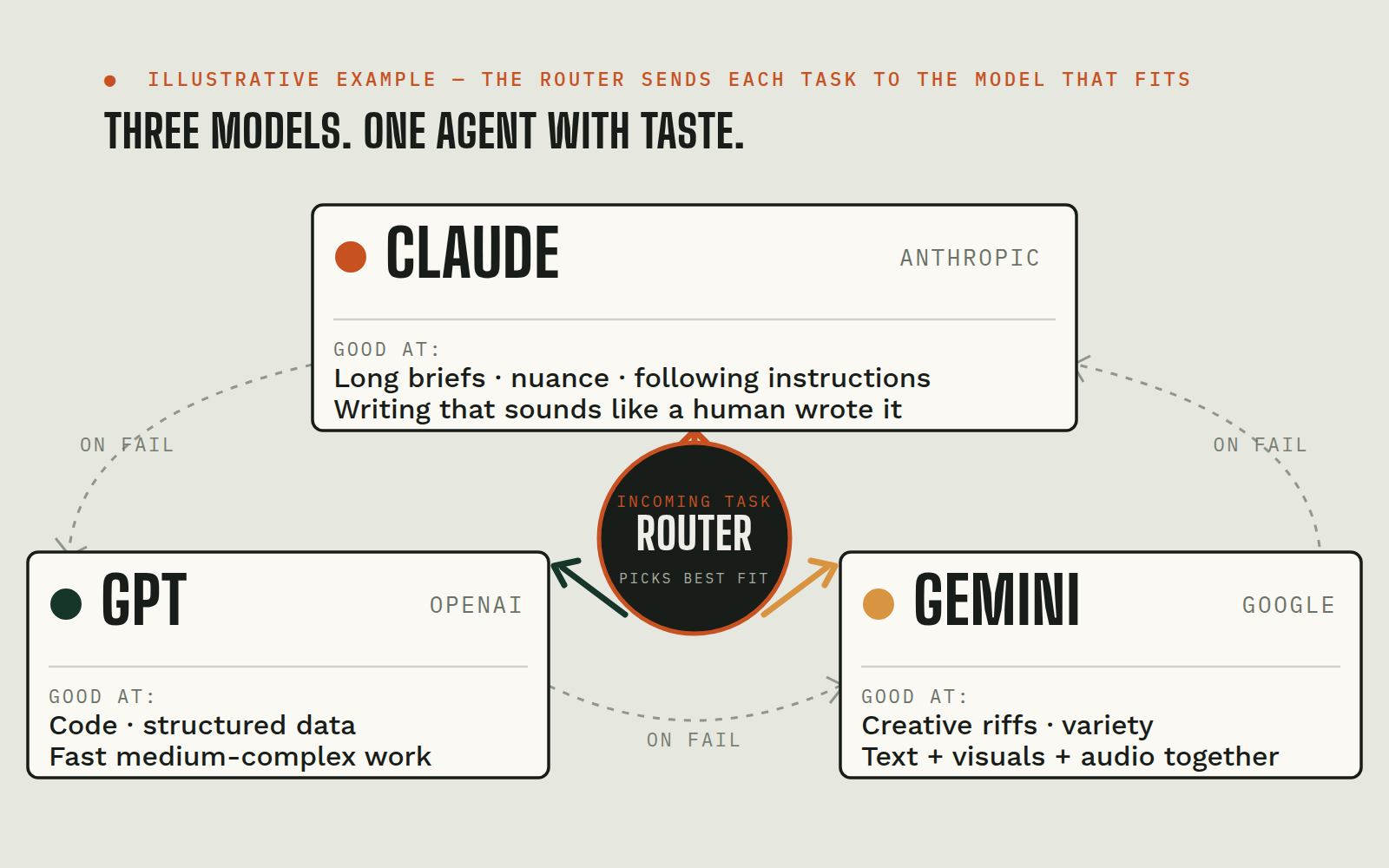
Fallback isn't only for emergencies. The same plumbing lets us route by strength:
- Claude → long briefs, careful instructions, writing that sounds like a human, work where "follow the rules exactly" matters.
- GPT → broad general knowledge, code, structured data, fast turnaround on medium-complexity tasks.
- Gemini → creative riffs, image understanding, brainstorming where variety is the point, working across text + visuals + audio in one go.
An agent asked to write a case study from a sales call might go: Claude for the draft (voice + nuance), GPT for the data table (structure), Gemini for the headline options (variety). Three models, one deliverable, none of them doing the job the others would do worse. That's not three agents. That's one agent, with the taste to pick the right tool.
The Big Timber truth
A single-model AI is a single point of failure. On the day it fails, it fails your whole business. The agents we deploy for clients run on at least two models, usually three — one preferred, one backup, one creative wild-card. The switch is automatic, under a second, and invisible to the end user. The bill is slightly higher (we pay for multiple accounts, not one). The uptime is wildly better.
If your current AI setup can be killed by one company's bad afternoon, you don't have a resilient system. You have a vendor you're hoping has a good week.