Recurring Client-Report Chore → Reusable Agent Procedure in One Sitting
The chores that come back every week deserve to be defined once, not re-done every week.
What was getting in the way.
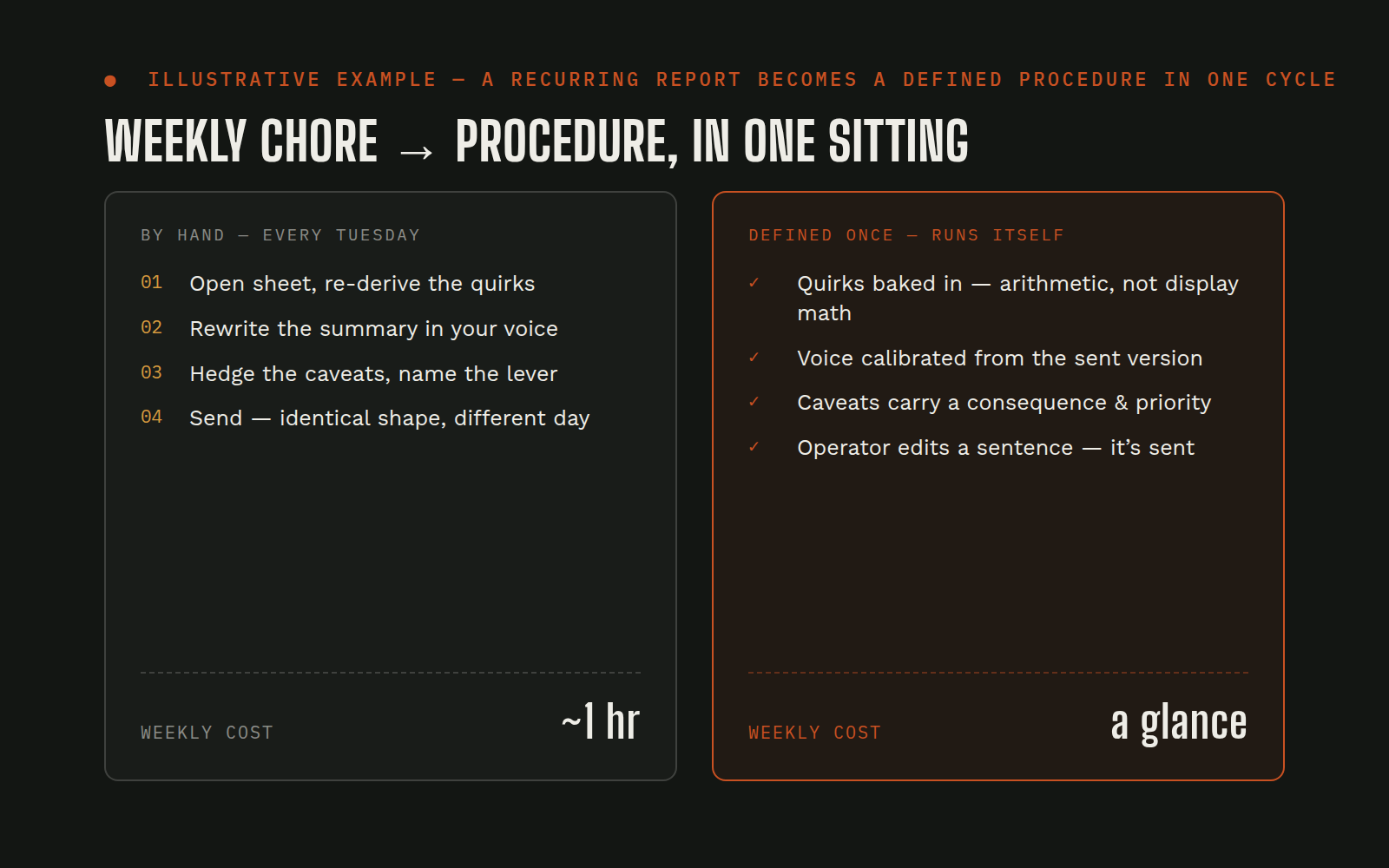
Weekly client KPI emails are a chore that recurs forever: pull the sheet, read the numbers, write the summary, send it. Done by hand, each one takes an hour and produces a slightly different-shaped email because the writer is tired on different days. The sheet itself has small quirks only the operator has learned to work around — the "revenue" row includes unprocessed orders, the ROAS column is built on a non-cash figure, the YoY column compares year-to-date against a full prior year. The quirks get re-navigated every single Tuesday.
Context
Universal — the pattern applies to any recurring report delivered to any stakeholder on a cadence.
How the work runs.
- 01
Start with the real chore
The agent reads the actual spreadsheet the operator pulls from every week, section by section, before writing a line of procedure — the automation can't be better than its understanding of the real artifact.
- 02
Prove the sheet's math from scratch
The agent recomputes each headline figure from the underlying rows and names where the sheet's own numbers diverge from the arithmetic — one revenue row includes unprocessed orders, one ROAS column is built on a figure that isn't cash, one YoY column compares a partial year against a full one. The agent's version matches the arithmetic, not the display.
- 03
Draft the first week's email, then show its own work
The agent delivers the Tuesday email and, alongside it, the diffs between the sheet's reported numbers and the recomputed ones, so the operator sees exactly which quirks are being handled and why.
- 04
Learn from the version the operator actually sent
The operator edits the draft and sends. The agent diffs the sent email against its own draft and extracts the operator's rules — bullets hang off a prose lead, recency only, credit the client's own lever by name, caveats carry a priority and a consequence — and writes them into an account override on the standing procedure.
- 05
The next week starts calibrated
The following Tuesday the first draft already reflects every rule the operator applied last time. The chore no longer needs the operator's attention until the numbers themselves need discussion.
Evidence from the workflow.
Each system has a role.
Intake (single source of truth for the week's numbers)
Client reporting spreadsheet
Signal (sanity-check the sheet's arithmetic)
Marketing dashboards (ads platforms, analytics)
Record of truth (standing skill + account overrides)
Agent procedure library
Action (where the draft lands and the operator edits)
Team chat
Why this is Operator.
Owns a workflow end to end, running the process inside the authority you set.
- 01
The agent drafts; the human sends. Numbers come from the live sheet (never from memory), and divergences between the sheet's display math and the arithmetic are surfaced in the draft, not quietly corrected. Account-specific overrides capture tone and emphasis — never invented facts.
Impact / Outcomes
A recurring weekly chore converts into a defined procedure in a single sitting, with the operator's voice calibrated in one revision cycle instead of four.
Known sheet quirks (unprocessed-orders inclusion, non-cash ROAS, mixed-length YoY) are handled by the agent arithmetically — the operator no longer has to remember them under time pressure.
The procedure travels: the same skill, with per-account overrides, handles the weekly email for any client whose reporting looks structurally similar.
Find where a workflow like this fits.
Start with the systems, work, constraints, and authority already present in your operation.