First-Party Identity Graph: Attribute an Email Lead With No Form And No Call
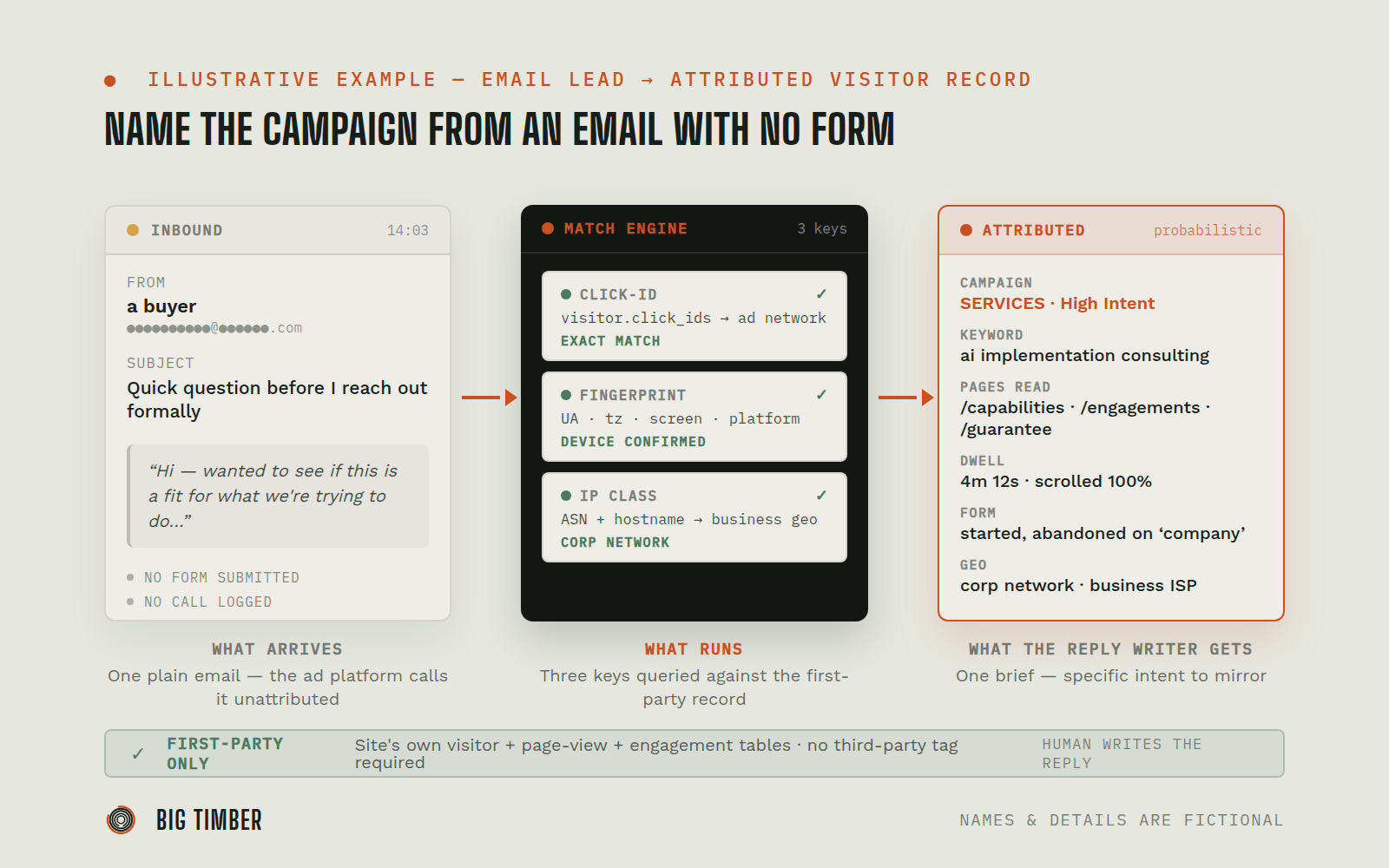
Turn any inbound email into a full attributed visitor record — ad campaign, keyword, pages read, time on each section, device, geography — using first-party data the site already captures, with no form fill and no call needed.
What was getting in the way.
A real buyer lands on the site from a paid ad, reads the pages, decides to reach out — then skips the form and the phone and just sends a plain email. The ad platforms report an unattributed inbound. The team gets a one-line note with no idea which campaign earned it, what the person read, or what to lead the reply with. The paid budget takes the blame; the real signal evaporates.
Context
A buyer arrives from a paid ad, reads the pages, then emails rather than filling the form or calling. Common pattern for high-intent researchers who want to vet the fit before disclosing their stack or role on a public form.
How the work runs.
- 01
Capture every visitor first-party, from day one
The site writes its own small record of each visit — the pages, the referring ad click ID, the browser fingerprint, the IP — into its own database. No third-party tag required, nothing a browser can block.
- 02
Receive the inbound email, extract the signal
The email usually carries a tracking click ID in the signature link, or arrives from a device that has already visited. Either one is enough to key the lookup.
- 03
Match the lead against the first-party record
The agent queries the visitor database — click ID first, then device fingerprint, then IP class — and pulls back the matching visitor's complete footprint: ad campaign, keyword, every page viewed, how long they stayed on each section, and whether they started and abandoned a form.
- 04
Enrich the IP for business context
The visitor's IP resolves to a hostname, an ISP, and a geography — enough to confirm a corporate network, a known SaaS tenant, or a home-office pattern consistent with the person's role.
- 05
Hand the reply writer a one-page brief
Which ad brought them, which pages they actually read, what they lingered on, what they abandoned, where they were sitting when they wrote — so the reply opens with specific, scoped intent instead of a generic greeting.
Evidence from the workflow.
Each system has a role.
Visitor + page-view + engagement tables on the website's own database
First-party attribution store
Campaign and keyword register for the click-ID lookup
Ad platform account
Hostname, ISP, and geography enrichment
IP intelligence lookup
Runs the matched-identity query and composes the one-page brief
Agent query layer
Why this is Operator.
Owns a workflow end to end, running the process inside the authority you set.
- 01
Only first-party data the site already collects for its own analytics is used; the agent reads from the site's own database, not any third-party vendor. IPs are stored at the class level and hashed where surfaced; the enrichment lookup returns only business-grade hostname/ASN, never a person. The identity match is probabilistic and labeled as such in the brief — a human writes the reply and makes the final judgment on who the person is. No outbound action fires from the match; the output is a reading of the record, nothing more.
Impact / Outcomes
Named the originating campaign and company context for an inbound email that carried no form and no call
Reconstructed the lead's multi-day footprint — device, city, ISP, pages read, section dwell times, the form field they abandoned on — from the first-party record alone
Gave the reply writer specific intent to mirror, replacing a generic reply with a scoped one
Proved the paid campaign that would otherwise have shown as unattributed actually produced the lead
Find where a workflow like this fits.
Start with the systems, work, constraints, and authority already present in your operation.