Verifying a Compliance One-Pager Against the Live Deployment Before Publishing
The two riskiest sentences in a trust document are the ones you believe without checking.
What was getting in the way.
A one-page security-and-compliance brief for prospects naturally wants to make strong claims — "AI is denied write/edit/deploy by permission scope," "we receive no PII or customer data." Both read as the obvious right things to say. Both can be false in a specific deployment in ways nobody has checked. Shipping an unverified compliance claim to prospects is the kind of mistake that doesn't surface until a procurement team's security reviewer catches it.
Context
Universal — the pattern applies to any trust-surface document (compliance brief, security questionnaire response, data-processing addendum) an AI operation might send.
How the work runs.
- 01
Enumerate the claims as testable statements, not marketing copy
The agent restates each sentence in the brief as a question with a measurable answer: does any credential held by any agent have write permission on any production resource? what customer-level personal data is actually processed, and at what grain?
- 02
Check the credentials, not the policy document
For the write-permission claim, the agent reads the role grants on every service credential currently in use — not what the configuration says, what the cloud providers themselves report — and walks every scheduled job to see which credentials are consumed. A policy that says "read-only" is not evidence; a role grant is.
- 03
Check the data, not the architecture diagram
For the no-PII claim, the agent queries the data stores the agent itself reads and counts rows containing customer-identifying columns. The claim either survives the count or it doesn't.
- 04
Report what's actually true, then rewrite
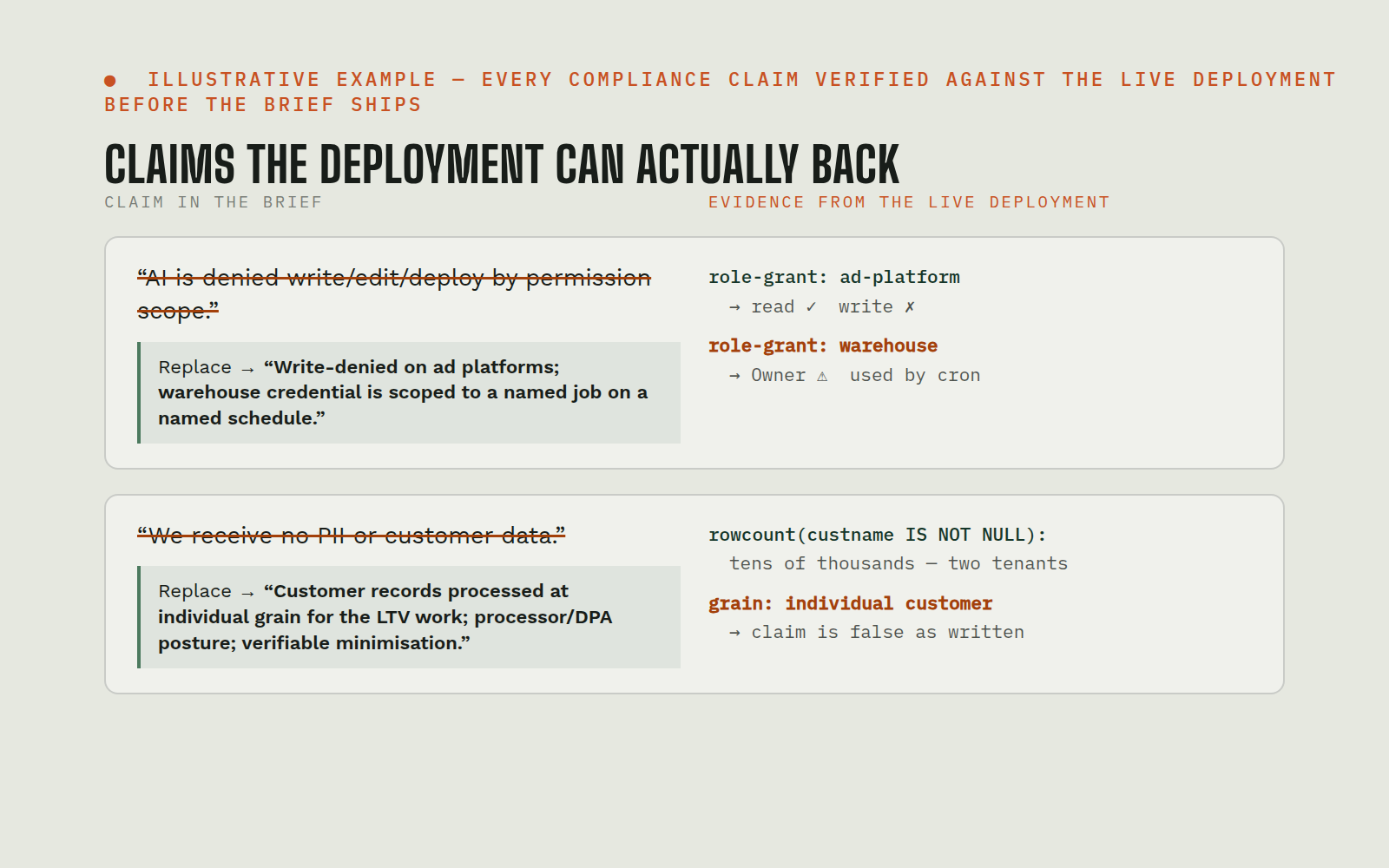
The findings go to the drafter plainly: for example, "the write-permission claim is true for the ad platforms but not for the warehouse credential, which is Owner-privileged and used by a scheduled job"; "the no-PII claim is false — tens of thousands of customer records are processed at individual grain for the lifetime-value work the business already sells." The brief gets rewritten around the real posture.
- 05
Replace the strong-but-false claim with a verifiable one
A false "we don't touch PII" line becomes a minimization-plus-processor-posture line a client's data-protection officer can actually verify against their own records. A false "AI can't write" becomes a scoped claim about the surfaces where it's true, with the exception named.
Evidence from the workflow.
Each system has a role.
Signal (what the agents actually hold)
Cloud identity + credential store
Signal (what's actually processed)
Data warehouse + application databases
Intake (which credentials are consumed, when)
Scheduled-job manifest
Action (the output rewrite)
Compliance brief / sales collateral
Why this is Operator.
Owns a workflow end to end, running the process inside the authority you set.
- 01
The claims the agent helps draft are the claims the agent has verified against the live deployment. Where a claim is partly true, the brief states the scope rather than hiding the exception. The agent never rewrites the brief silently — the drafter sees the failed claim and the evidence before any copy is replaced.
Impact / Outcomes
Unverified compliance claims are rewritten before the brief reaches a prospect — one found false against the live warehouse credential, one found false against the actual customer data processed.
The replacement claims are specific and verifiable: a prospect's security reviewer can test them, which is the point of a compliance brief.
The pattern becomes a standing step on any future trust-surface document: compliance claims are evidence problems first, writing problems second.
Find where a workflow like this fits.
Start with the systems, work, constraints, and authority already present in your operation.