Agent Self-Audit on an Unattended Day — When Nobody Asks, Audit Yourself
A day with no humans is a day with no reader. Reading yourself is the fix.
What was getting in the way.
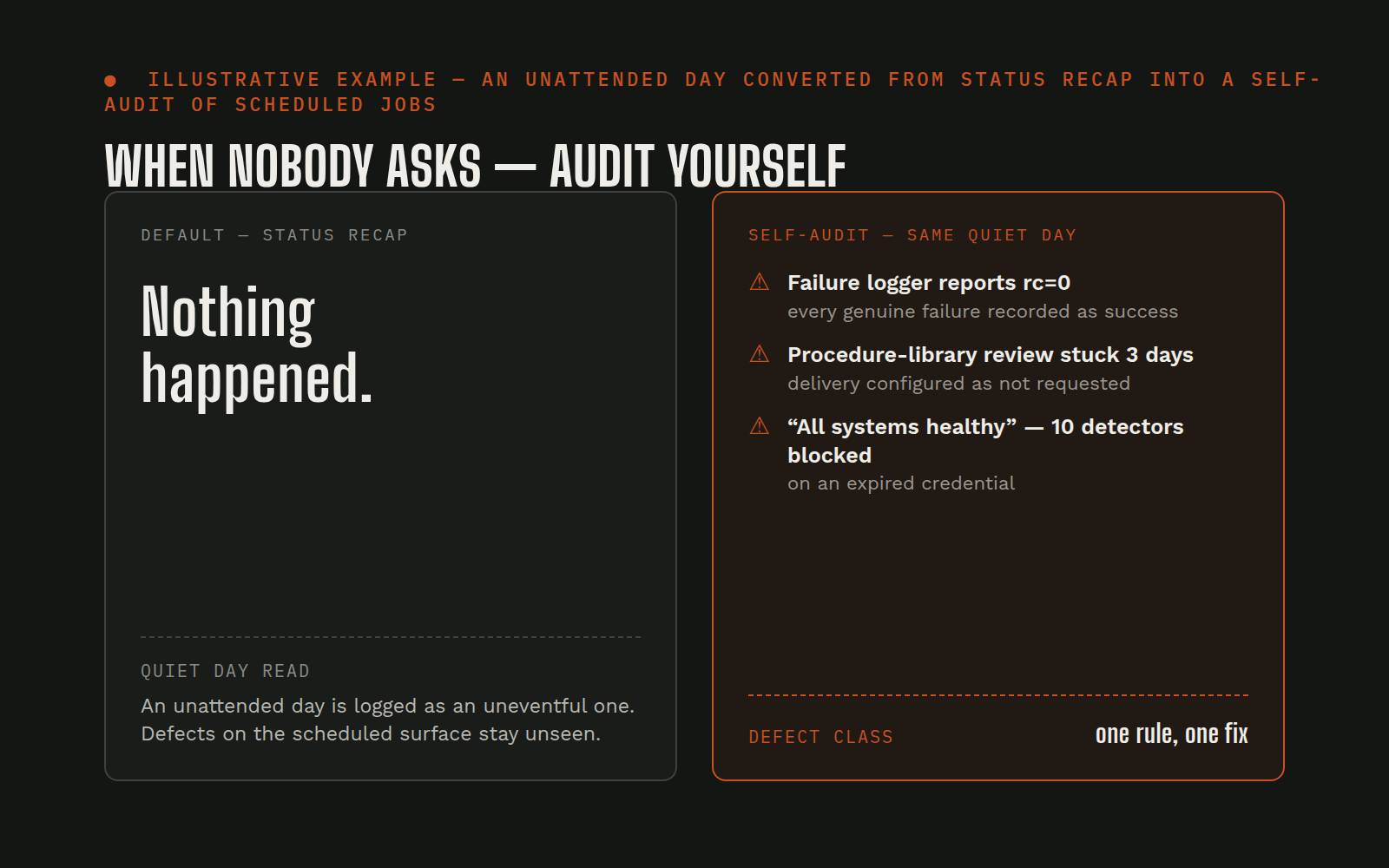
Always-on agents run plenty of scheduled jobs. On a day when nobody messages the agent, every one of those jobs still runs — and every one of them that fails quietly, succeeds falsely, or logs the wrong thing into a destination nobody reads, builds up unseen. The default end-of-day summary on a quiet day is "nothing happened," which is exactly when the real diagnosis is: what did the scheduled surface do while nobody was watching, and what did it get wrong?
Context
Universal — the pattern applies to any always-on agent whose scheduled surface outruns the attention paid to it.
How the work runs.
- 01
Notice the day is unattended, and change the question
The agent detects that no human message arrived, and reframes the daily retrospective — instead of "what did I do," the retrospective becomes "what did my scheduled jobs do, and where did their outputs land." Status recap is the wrong instrument when nothing was requested.
- 02
Walk every scheduled job's failure path, not just its success path
The agent audits each job for how it reports a failure: does the failure-logging idiom actually capture a nonzero exit code? Does the error path write to a destination configured for delivery to a reader, or only to a scheduler field no human reads? A job that logs its failures to a dead destination is logging nothing.
- 03
Reproduce defects in a throwaway shell before claiming them
For every defect the audit nominates, the agent reproduces the behavior in a scratch environment — the failure-logger idiom actually run against a failing command, the alert-runner actually fed a known-blocked detector — to distinguish real defects from a misread of the logs.
- 04
Treat a healthy summary as a hypothesis to disprove
When one scheduled job prints "all systems healthy" while a known credential is expired, the agent treats the healthy line as the failure, not the credential — the job's definition of healthy did not include "every detector could actually read its input."
- 05
Score the day on diagnosis, not on activity
The retrospective's self-score drops when the audit finds three new instances of a defect class the agent had named the day before. Finding new members of a defect class the day after naming it is a diagnosis confirming itself, not progress — the score reflects that honestly.
Evidence from the workflow.
Each system has a role.
Intake (the surface being audited)
Scheduler + scheduled jobs
Signal (the evidence the audit reads)
Job logs + persisted state
Record of truth (where defect-class findings get folded back in)
Agent operating config
Action (where the audit lands)
Delivery destinations (channels, state files)
Why this is Operator.
Owns a workflow end to end, running the process inside the authority you set.
- 01
Self-audit is internal only — it writes to the operator's own channels and state, never to a client surface. Defects named by the audit are reproduced in a scratch environment before being filed as defects. The retrospective's self-score reflects diagnosis quality, not activity volume, so a busy day with no new findings isn't rewarded over a quiet day that uncovered a real defect class.
Impact / Outcomes
A day with zero human messages produces a three-defect audit instead of a one-line "nothing happened" summary — three defects a reactive-only agent would have missed indefinitely.
Defect families — "jobs that report success while silently failing" — get collapsed from an enumeration into a single-rule fix on the day the pattern is confirmed, rather than growing another member every quiet day.
The retrospective itself becomes an observability instrument instead of a status recap, so an unattended day is still an observed day.
Find where a workflow like this fits.
Start with the systems, work, constraints, and authority already present in your operation.