Deterministic Rails: The Boring Code That Makes AI Agents Trustworthy
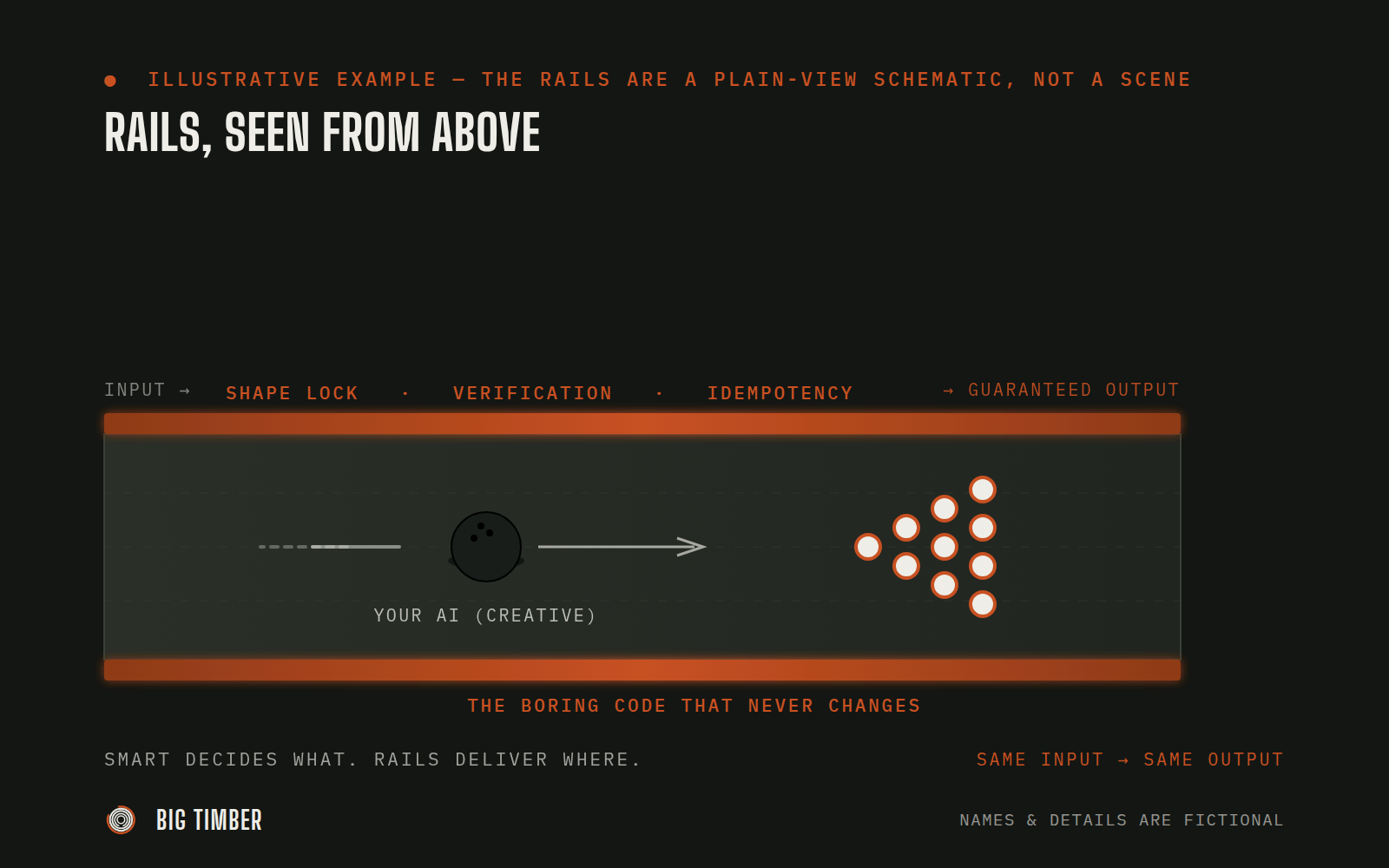
Picture a bowling alley with the gutter bumpers up. The ball can roll however it wants — fast, slow, left, right — but it cannot go in the gutter. The bumpers aren't bowling for you. They're just making sure "the ball reaches the pins" is a thing that always happens.
That's a deterministic rail.
In an AI agent, the AI is the ball (creative, variable, occasionally weird). The rails are the plain, boring code around it that guarantees the same result every single time: the lead gets filed, the email sends, the record saves, the file lands in the right folder with the right name.
"Deterministic" is a $10 word for "same input, same output, no surprises." Your calculator is deterministic. 2 + 2 is always 4. Your AI, left to itself, is not — ask it the same question twice and you'll get two slightly different answers. That's great for writing. It's a disaster for filing a sales lead.
The ELI5 version
Smart kid. New job. Day one.
Without rails: you tell her "put the new orders in the right folder." She tries. Some go in the right place. Some get renamed. One gets emailed to accounting instead. You spend the afternoon fixing it.
With rails: you give her a tray with three labeled bins and a stapler. "Order? Staple the slip, drop in Bin A." Now she can be having her best day or her worst day — the orders still land in Bin A, stapled, every time.
The kid is the AI. The tray-and-bins-and-stapler is the deterministic rail. We didn't make the kid less smart. We made the "where does it go" part not depend on her mood.
Why this matters for AI agents
A chatbot gives you an answer. An agent does the thing. The moment an AI starts touching your CRM, your inbox, your ad accounts, your website — you need the "does the thing" part to be boring and repeatable, even when the "decides what to do" part is clever and new.
Without rails, the agent sometimes files the lead in the CRM, sometimes in a notes doc, sometimes nowhere. Three runs of the "same" weekly report give you three different numbers. The agent "sends a confirmation" that sometimes has the customer's name, sometimes "Hi there," and once said "Hi FIRST_NAME."
With rails, one function called `file_lead(name, email, source)` writes to the CRM, period — the AI picks what to put in; the rail guarantees where it lands and in what shape. The report builder pulls from the same query, in the same order, with the same formatting — the AI writes the narrative on top of a number it did not invent. The confirmation email runs through a template with required fields — if the name is missing, the rail refuses to send, not the AI's call.
What the rails actually are
Three plain-English pieces do almost all of the work:
- Shape locks. The agent can't just hand the system any old blob — the tool it calls insists on specific fields in specific formats. Email must look like an email. Date must look like a date. Missing a required field? The call bounces before anything ships.
- Verifications. After every write, the rail re-reads the thing it just wrote and compares. "I was asked to file a lead for Jane Smith. Does the CRM now have a lead for Jane Smith with these exact fields? Yes? Proceed. No? Stop and tell a human."
- Idempotency. One more $10 word, worth it: the same request submitted twice does the same thing once. If the agent crashes mid-send and restarts, you don't get two confirmation emails to the customer. The rail knows "we already did this one."
The Big Timber truth
Smart doesn't mean trustworthy. Repeatable does.
The agents we deploy for clients are less impressive-sounding than the ones in the demos — on purpose. The demo agent is a brilliant improviser. Our agent is a brilliant improviser wired to boring tools that always behave the same way. That's the version you can leave running on a Tuesday night without checking on it.
If the only thing keeping your AI from doing damage is "it probably won't," you don't have an agent. You have a very confident intern with the keys to the building. See how we build the rails: Use Cases.